Easy Sofa Vs Couch Makeover Ideas for Beginners
Learn how to style sofa pillows with a simple size, color and texture formula, plus how many to use and the mistakes that make a couch look messy.

By Julio Arco
Architect and online interior designer

In this post
The simplest way to style sofa pillows is to pick a small color palette, mix one solid with one pattern and one texture, and layer big pillows at the back with smaller ones in front. For a standard three-seat sofa, three to five pillows is plenty.
It's very common to buy pillows one at a time and end up with a pile that doesn't quite work together, so don't feel bad if that's your couch right now. A few rules fix most of it.

Start with size and scale
Pillow size sets the structure. The back row gets the largest pillows, about 22-24 inches square, because they fill the gap between the seat and the wall of the sofa back. Mid-size pillows of about 18-20 inches go in front of those, and a small lumbar pillow of roughly 12x20 inches finishes the arrangement.
Match scale to the sofa. A deep, oversized sofa can handle big pillows, while a compact loveseat looks buried under them. If the pillows hide the seat, they're too big or there are too many.
How many pillows on a sofa?
A rule of thumb for couch pillows: use an odd number on a standard sofa, usually three or five, and keep the count lower on small ones. Two to three suits a loveseat. A sectional can take more, but split them by section instead of heaping them in one corner.
Odd numbers feel a little more relaxed because the arrangement isn't a mirror image. Even numbers work fine if you want a formal, symmetrical look. And if you or your dog actually sit on the sofa, fewer pillows is the honest answer. Someone has to have a place to land.
Keep a cohesive color palette
Choose two or three colors and repeat them. Pull one from a rug, art or curtains, and let the sofa's own color act as the quiet background. The eye reads the sofa as the base and the pillows as the layer on top, a basic figure-ground relationship that Gestalt psychology describes as the first principle of how we organize what we see. If a pillow is nearly the same color as the sofa, it disappears. If it's wildly different from everything else, it jumps out as a mistake.
On a neutral sofa, you have the most freedom. If you're working with beige, I'd start with the ideas in how to decorate around a beige couch.
How to mix and match throw pillows
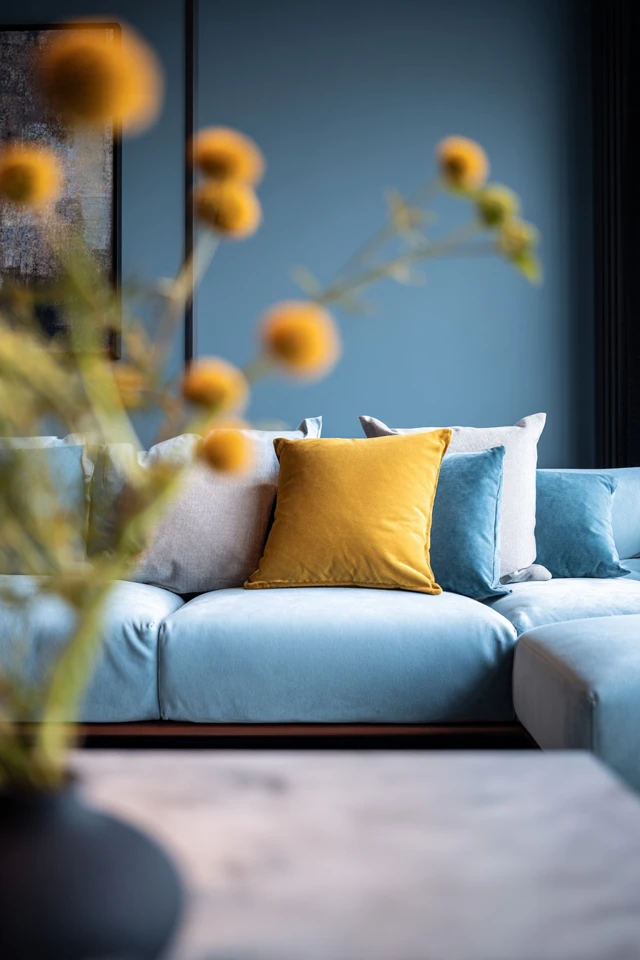
A reliable formula is solid, pattern, texture. Take one solid pillow in a main color, one patterned pillow that includes that color, and one pillow whose interest comes from fabric (bouclé, chunky knit, velvet or linen) rather than print.
Mixing patterns
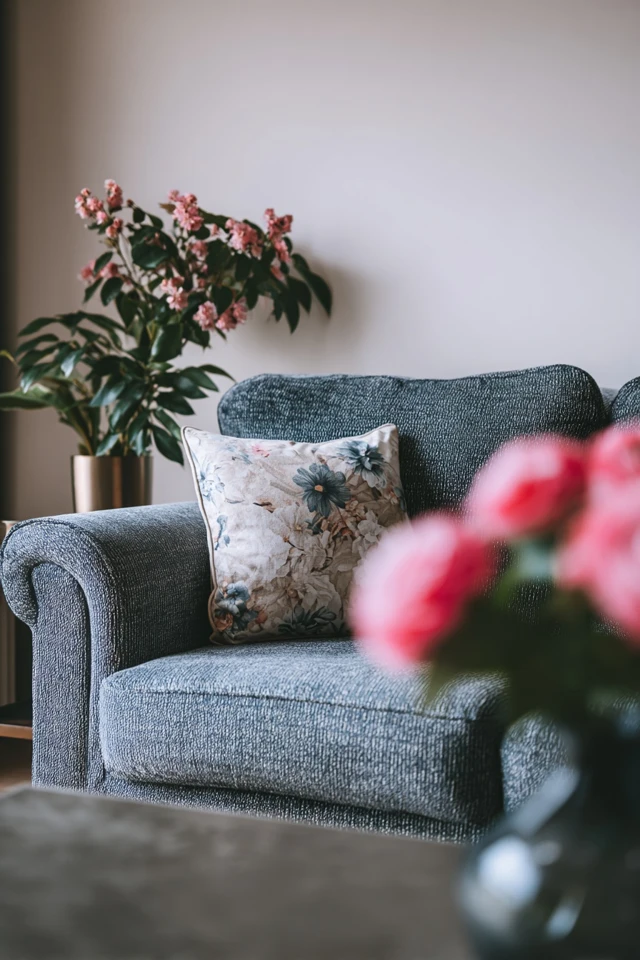
If you use two patterns, vary their scale: one large and one small, sharing at least one color. Two prints of the same size compete. Stripes, checks and florals can mix as long as the scale differs.
Mixing textures
Texture adds depth without adding more color, which makes it a good tool for a calm room. Glossy fabrics such as velvet catch light, while matte weaves such as linen absorb it. Put one of each side by side and the sofa looks layered instead of flat.

How to arrange pillows on a couch
- Place the largest pillows against the back, one at each end.
- Add mid-size pillows in front of them, angled slightly toward the center.
- Finish with a lumbar or small square pillow in front, on one side only.
- Step back and check the visual weight. Both ends of the sofa should feel roughly equal, even if the pillows differ.
Symmetry reads formal and calm. Asymmetry reads casual. Both work, so choose based on the room. As an architect, I'd go symmetrical in a room with strong lines and asymmetrical in a relaxed family room.
Vary shapes without overdoing it
Squares do most of the work. Add one rectangle (lumbar) or a round or bolster pillow for variety, but one unusual shape is enough. Three different shapes on one sofa start to look like a display shelf.
Fill matters as much as the cover. Feather or down-alternative inserts can be fluffed and give a relaxed shape, while foam inserts hold their lines but look stiff. Buy inserts one size larger than the cover so the corners fill out.

Throw pillow mistakes to avoid
- Matching every pillow exactly. A set of four identical pillows looks like it came from a showroom, not from your life.
- Too many pillows. If you move them all every time you sit, you won't keep them arranged.
- Ignoring the rest of the room. Pillow colors should connect to something else nearby.
- Thin, flat inserts. Limp pillows make a sofa look tired no matter how nice the covers are.
- Delicate fabrics on a sofa pets use. Pick covers with removable, washable zippers, and keep a spare set for laundry day.
I recommend washable covers on any pillow a dog is allowed to climb on. If your sofa is part of a bigger layout puzzle, such as an L-shape, see how to arrange an L-shaped sofa before you buy pillows.
Pair pillows with a throw and a rug
A folded or draped throw adds one more texture and gives the pillows somewhere to rest visually. Drape it over one arm, not across the whole seat.
If you place a rug under the sofa, keep its edges flat. Research on rug and carpet falls notes that loose throw rugs and curled edges are among the factors most often mentioned as unsafe, so use a rug pad, especially in a room where people and pets cross often.
Frequently asked questions
What is the best way to style pillows on a couch?
Layer them: large pillows at the back, mid-size in front, and one small lumbar pillow on top. Keep the colors within one palette and mix a solid, a pattern and a texture.
What is the rule of thumb for couch pillows?
Use an odd number, usually three or five on a standard sofa, and vary size and texture while repeating a color. Fewer is better on a loveseat.
What is the 2/3 rule for sofas?
It isn't a fixed design standard, so treat it with caution. A related guideline is to let about two-thirds of the pillow mix be your main colors and one-third accents, which keeps the sofa from looking busy.
Should throw pillows match the sofa?
They shouldn't match exactly. Choose pillows that coordinate with the sofa and the room, in similar tones or one repeated accent color, so they stand out from the upholstery.
Filed under
ArticlesMeet the author
Written by an architect.
Julio Arco is a passionate architect with years of experience in architecture, interior design, urban design, and housing. He studied at prestigious universities across North America and Europe.

- Name
- Julio Arco
- Job
- Architect and online interior designer
- Studied
- Architecture, ITESM · Urban Design and Housing, McGill
- Partner
- Thor, Australian Shepherd
- Thor’s title
- Head of quality control