Fold Away Desk Ideas for Small Spaces and Warm Homes

By Julio Arco
Architect and online interior designer
In this post
The best fold away desk ideas share one trait: they give you a real work surface when you need it and give the floor back when you don't. In a small room, a wall-mounted fold-down desk is usually the strongest choice, followed by a desk hidden inside a cabinet or dresser.
Styling matters as much as the hardware. A fold-down desk that looks like part of the room gets used, and one that looks like an afterthought collects laundry. Below you'll find the main types, how to pick one, and how to make it look good open and closed.
Which fold away desk ideas work best in small spaces?
Here are the formats that make the most sense for fold away desk ideas for small spaces, from most to least wall-dependent.
Wall-mounted fold-down desks
A wall mounted fold away desk is a hinged panel fixed to studs. Closed, it reads as a shallow shelf or a framed panel. Open, it gives you a surface that is typically 12-24 inches deep, held up by brackets or a drop-down leg. It's the simplest option for a hallway, a bedroom corner or the end of a living room wall. Fix it into studs or solid blocking, and ask a licensed professional if you aren't sure what is behind your wall.
Hidden desks in dressers, cabinets and wardrobes
Hidden desk ideas for small spaces include a cabinet with a fold-out front, a sideboard with a pull-out shelf, or a wardrobe whose interior holds a desk. Doors closed, the room looks like it has plain storage. This suits living rooms where you don't want a workstation visible during dinner.
Fold away desk ideas with drawers
If you need paper, chargers and pens close by, look for a unit with drawers or cubbies under or beside the folding top. Shallow drawers are enough. Keep the heavy items low so the hinge isn't carrying them.
Leaning, ladder and secretary styles
Leaning desks need no mounting, which helps renters. A small secretary desk has a drop-front lid that doubles as the work surface and hides clutter behind it. Both take a bit more floor space than a wall-mounted panel.
DIY fold away desk ideas
A DIY fold-down desk can be as simple as a sealed plywood or solid-wood board, two heavy-duty folding brackets and a few screws into studs. Measure the depth you need, check the bracket's weight rating against your laptop and monitor, and sand the front edge so it feels good under your forearms. If you're comfortable with a drill, it's an afternoon project.
What is a Murphy desk?
A Murphy desk is a desk that folds up or down against a wall or into a cabinet, borrowing the idea from the Murphy bed. When it's closed it takes up almost no floor space, and when it's open it works like a normal desk. Some versions are wall-mounted panels, others are full cabinets with shelves around the work surface.
How do you set up a fold-down desk so it's comfortable?
A desk you can't sit at for an hour isn't saving you anything. The Occupational Safety and Health Administration's workstation guidance says elbows should stay close to the body and be bent between 90 and 120 degrees. It also notes that working in a neutral position reduces stress and strain on muscles, tendons and the skeletal system.
In practice that means:
- Choose a mounting height so your forearms rest on the surface with your feet flat on the floor. Standard desk height is about 28-30 inches, so mount accordingly.
- Leave knee room underneath. Drawers or shelves under the top can cut into it.
- Raise a laptop on a stand or a few books so the top of the screen sits at or just below eye level, as OSHA's computer workstation page recommends for monitors, and use a separate keyboard.
- Pick an armless chair that tucks fully under the open desk.
- Plan power. A cord running across the floor to a wall outlet gets old fast, and an outlet beside the desk is better. For new wiring, hire a licensed electrician.
As an architect, I'd mount the desk before choosing the chair, because the desk height is the fixed part and the chair can adjust.
How do you make a fold-out table look nice?
The trick is to style two states: open and closed.
Closed
Treat the closed panel as a piece of wall. Paint it the wall color so it disappears, or cover it with wallpaper or fabric-wrapped cork so it becomes a feature. A cork board on the front doubles as a message center. If the desk has a visible face, repeat a finish from the room, such as the same wood tone as a nearby shelf or picture frames.
Open
Keep the surface nearly empty: a lamp, a notebook, a mug. Add one soft texture, like a felt desk mat, to take the edge off a hard top. A small plant on a shelf above is fine, but anything on the desk itself has to be moved before you fold it up, so keep that list short.
Color and material
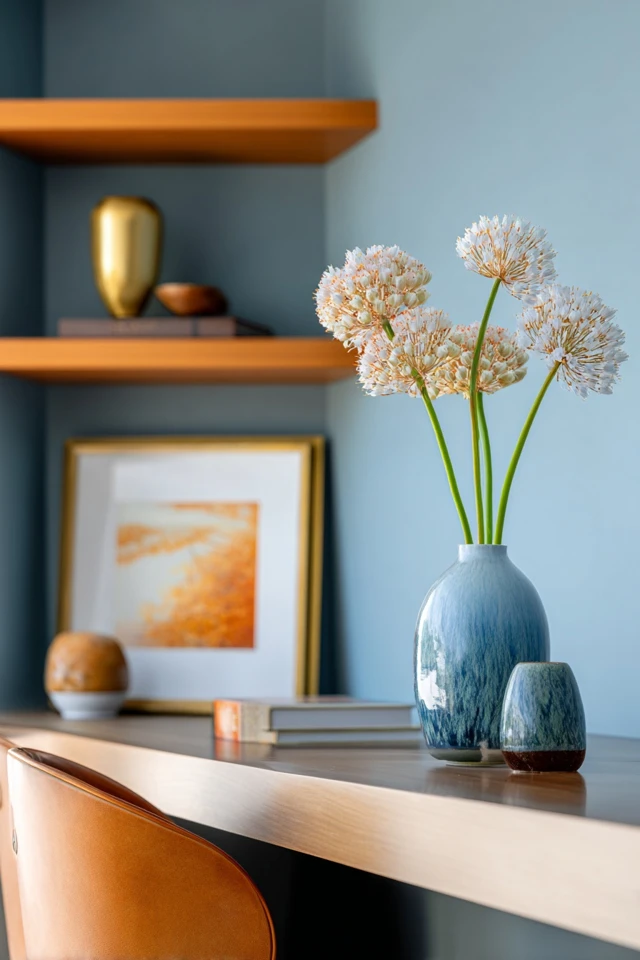
Warm neutrals such as cream, soft taupe or greige make a small desk feel less like an office. Wood tops add warmth, and a matte wall behind a glossy or sealed top gives a gentle contrast. Stick to two or three main colors, and repeat them in the chair, the lamp and the art nearby. In a dark room, warmer tones help. In a very bright room, cooler ones can reduce the glare feeling.
If your fold-down desk is in a darker room, take a look at this black office for how deep colors can still feel cozy.
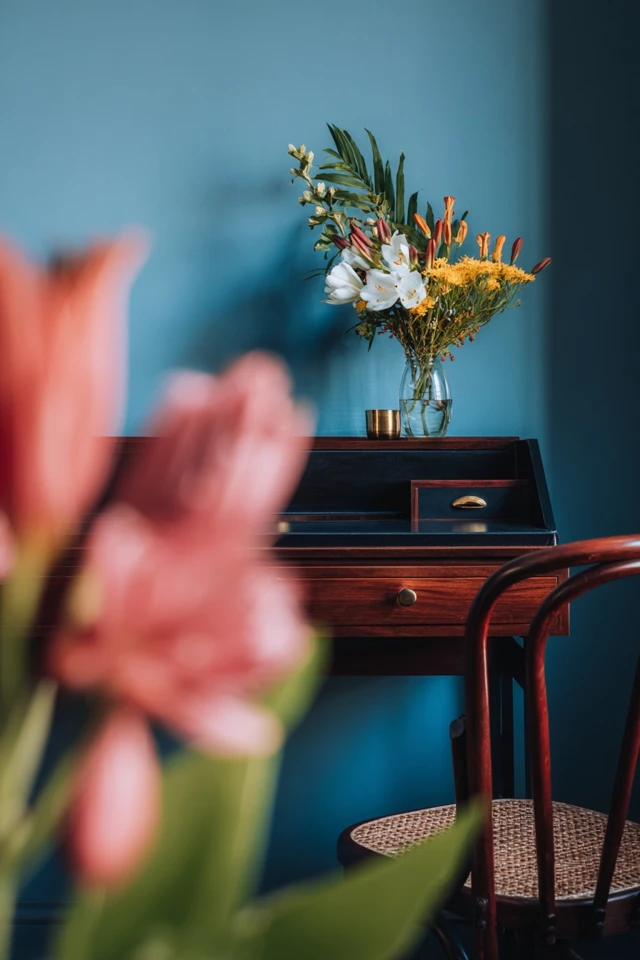
Where should a fold-down desk go?
- Near a window, so daylight falls across the surface from the side rather than straight into your eyes.
- Along a wall that isn't a main walkway. Leave about 30-36 inches clear in front of it so you can open it and pass behind the chair.
- Away from doors that swing into the desk area.
- In a sunroom or alcove, if you have one. See these small sunroom ideas for related layouts.
Add a task lamp, since overhead light alone leaves shadows on the page. Wall-mounted organizers or a slim shelf above the desk keep the surface clear without taking floor space.
Pet-aware tips
If you share your home with a dog or cat, check that the folded panel latches securely so it can't swing open on a curious nose. Tuck cables into a lidded box or a cord cover, since chewing on cords can hurt pets (ask your vet if your animal is a chewer). A closed desk also keeps pens and small items out of paws.
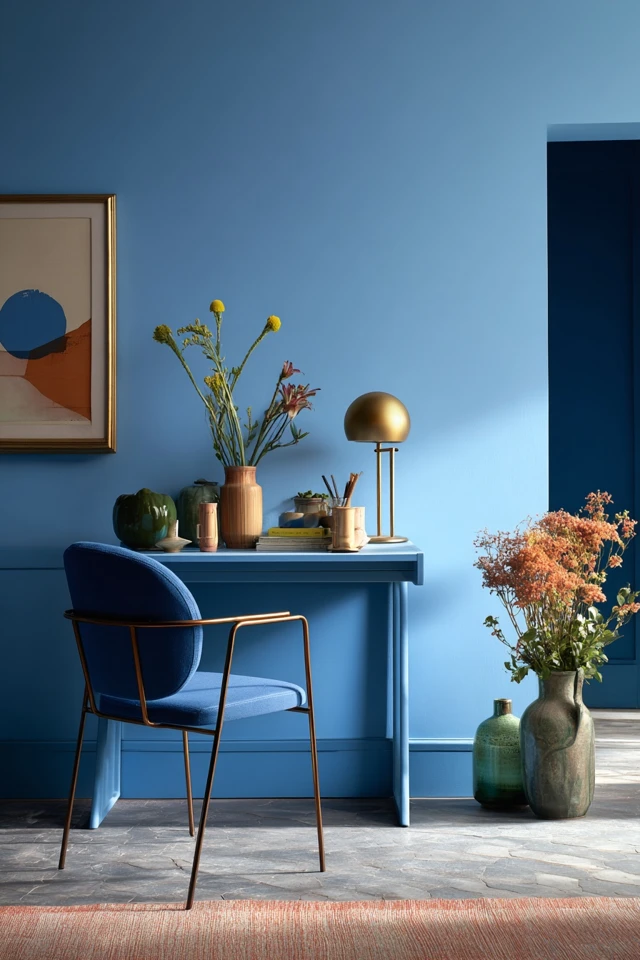
For more options, browse these fold away desk ideas for a stylish home.
Frequently asked questions
What is a good desk that can fold up?
A wall-mounted fold-down desk is the most space-efficient choice, since it folds flat against the wall. If you can't drill into walls, a leaning desk or a drop-front secretary desk works without much mounting.
What are some creative ideas for a desk?
Hide a desk inside a dresser, wardrobe or kitchen cabinet, or build one from a board and folding brackets. Another idea is a fold-down panel covered in cork or painted to match the wall.
How much space does a fold-down desk need?
Most need a work surface about 12-24 inches deep and roughly 30-36 inches of clear floor in front for the chair and walking past. Check the open depth before buying.
Filed under
ArticlesMeet the author
Written by an architect.
Julio Arco is a passionate architect with years of experience in architecture, interior design, urban design, and housing. He studied at prestigious universities across North America and Europe.

- Name
- Julio Arco
- Job
- Architect and online interior designer
- Studied
- Architecture, ITESM · Urban Design and Housing, McGill
- Partner
- Thor, Australian Shepherd
- Thor’s title
- Head of quality control