Lace Trim Bedding: How to Use It in a Modern Bedroom
Lace trim bedding can look modern, not frilly. Learn which lace to choose, where to place it, how wide it should be, and how to wash it.

By Julio Arco
Architect and online interior designer
In this post
- Why does lace trim work in a minimalist bedroom?
- Which type of lace should you choose?
- What color should the lace be?
- How wide should the lace trim be, and where does it go?
- How do you make the bed so the lace shows?
- What should you check before buying?
- How do you wash and care for lace-trimmed bedding?
- How should it change from room to room?
- Frequently asked questions
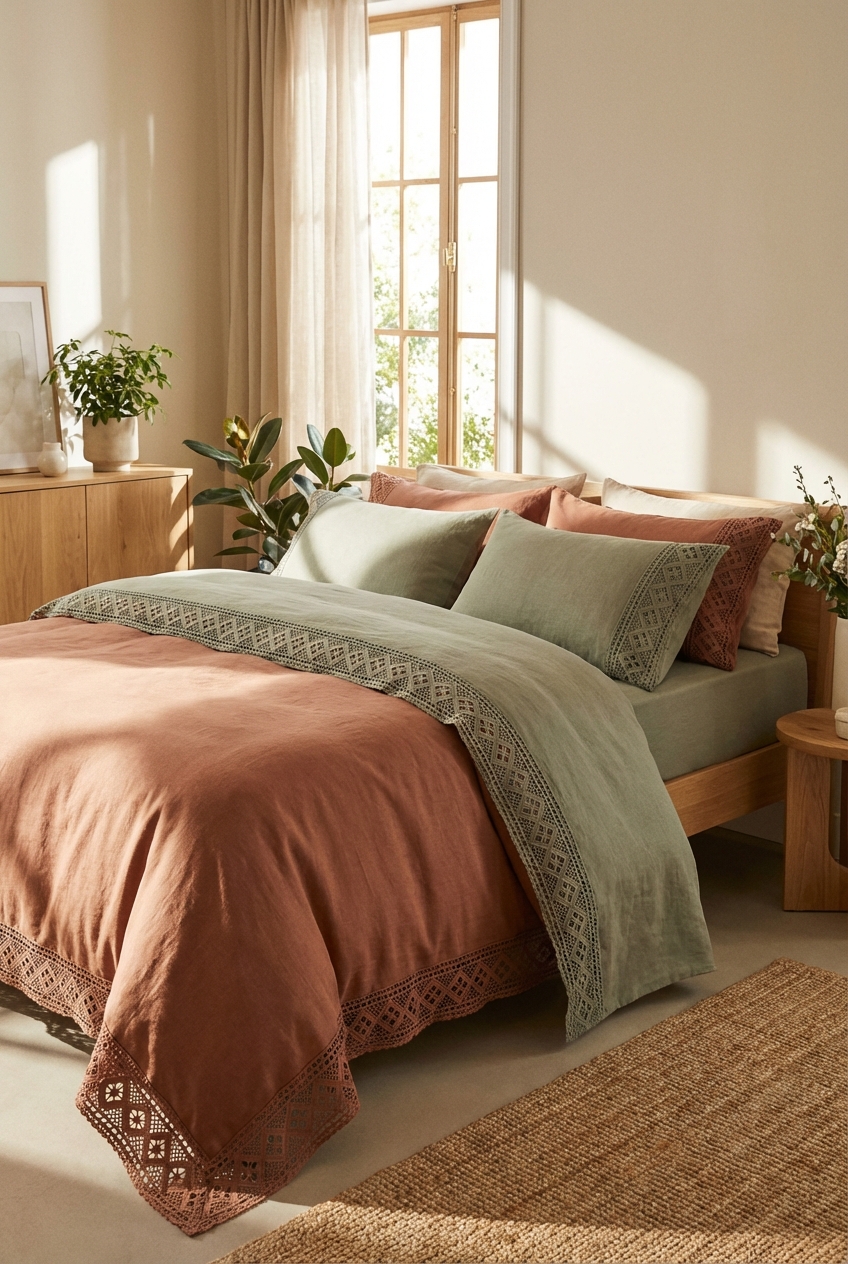
Lace trim bedding looks modern when the lace matches the fabric in color, sits on a crisp base like percale, and appears in only a few places on the bed. Think of it as one quiet line of texture, not a frilly set from head to toe.
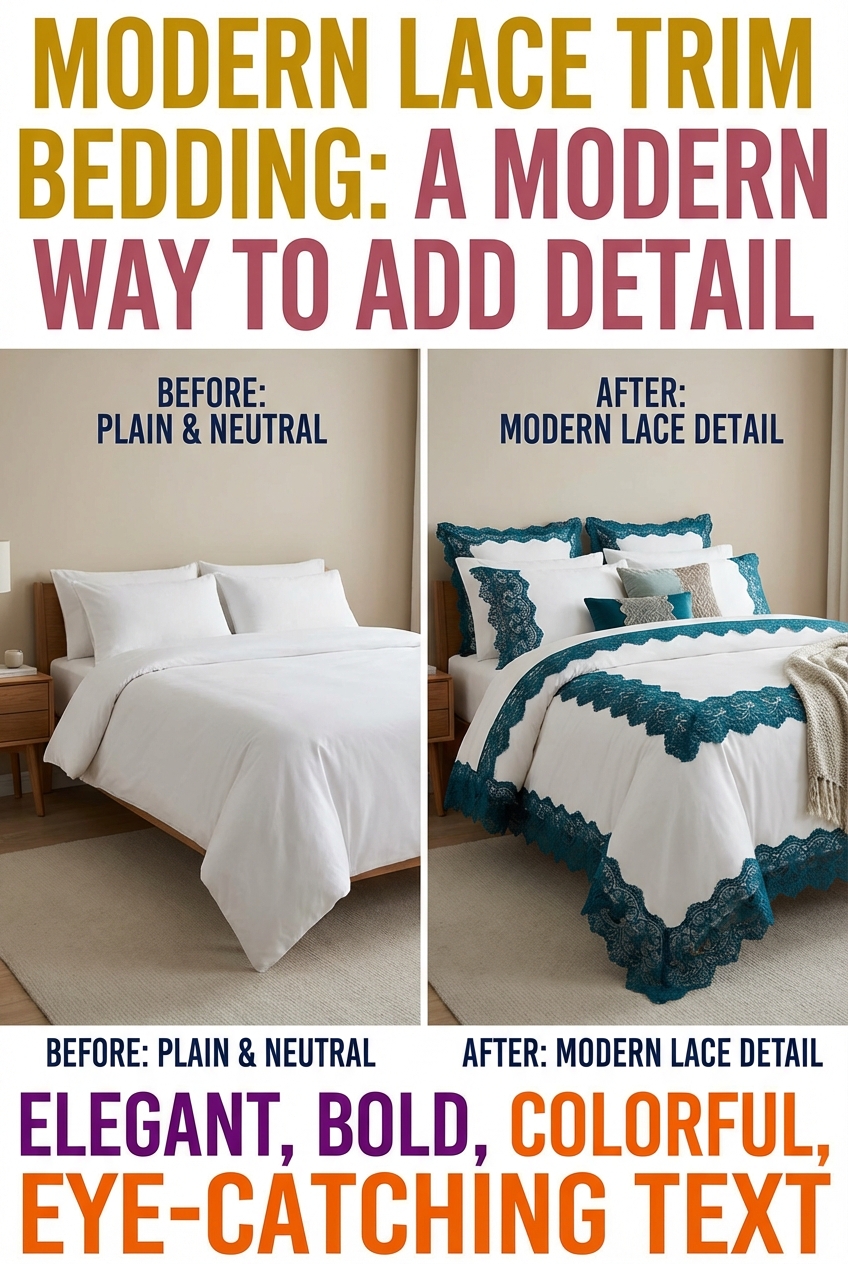
If lace makes you think of dusty parlors and scratchy doilies, that's a very common reaction. A narrow tone-on-tone border is a different thing: it adds small shadows to an all-white or all-cream bed that plain cotton can't give you.
Why does lace trim work in a minimalist bedroom?
When a room uses one or two colors, texture has to do the job that color usually does. Lace has relief, so it catches light on its raised threads and leaves tiny shadows in the openwork. Matte surfaces soften those shadows, glossy ones make them sharp, which is why lace on a matte cotton looks calm and lace on shiny polyester looks busy.
It also helps the edge read clearly. Visual perception sorts what we see into a figure and a background, as the University of Minnesota's introduction to the Gestalt principles describes with figure-ground. A lace border folded against a plain duvet gives your eye a clear figure to land on.
It's also a good option if you rent. You can't change the wall color or the light fixtures, but you can change the biggest object in the room.
Which type of lace should you choose?
- Eyelet (broderie anglaise): small embroidered cutouts. It's the most casual and cottage-like.
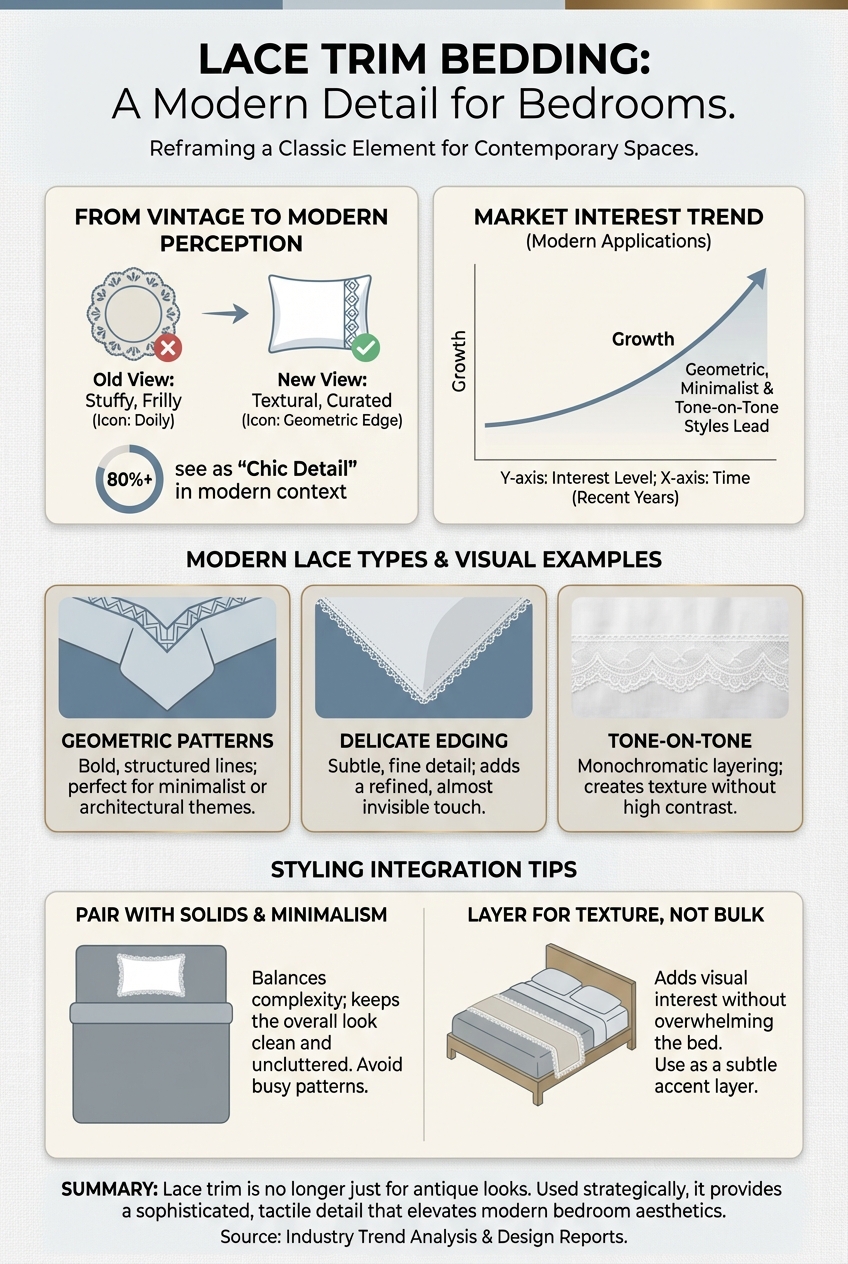
- Cluny: a heavier, geometric bobbin lace. As an architect, I'd pick this one for modern rooms because the weight feels substantial rather than precious.
- Chantilly: very fine, with floral detail. Keep it for decorative shams, not the sheet you sleep under.
- Crochet trim: common on linen, with a handmade feel that suits a relaxed, boho-minimal room.
For the base fabric, percale has a crisp matte finish that contrasts nicely with soft lace. Sateen has a sheen and a heavier drape, so it reads more formal.
What color should the lace be?
Keep it tonal. White lace on white cotton, or flax lace on flax linen, gives you a soft shadow line. High-contrast lace, such as black on white, tends to look like a costume. Check the fiber too: cotton and linen lace age into a soft matte finish, while polyester lace often has a plastic shine and can feel abrasive.

How wide should the lace trim be, and where does it go?
Scale the trim to the bed. On a twin, about 1-2 inches is plenty. On a queen or king, 3-4 inches reads from the doorway without taking over.
Use lace in two or three places: the top hem of the flat sheet, the pillowcase edges, and maybe one small lumbar pillow. Putting it on the duvet cover, every sham and the bed skirt is where a bed tips into lace fatigue. Pair a lace-trimmed sheet with a waffle-knit duvet or a smooth linen coverlet instead, and the contrast keeps it modern.
Leave the fitted sheet plain. It takes the most tension and rubbing, and lace there won't last. If you want more ideas for restrained texture, this guide to adding lace texture without clutter covers other rooms.
How do you make the bed so the lace shows?
- Start with a mattress protector and a plain, neutral fitted sheet.
- Lay the lace-trimmed flat sheet with its right side facing down. When you fold the top back over the duvet, the lace will face up and out.
- Tuck the sides with a hospital corner so the sheet stays taut and the lace doesn't bunch.
- Set the duvet about 12 inches below the headboard, fold the sheet over its edge (a fold of roughly 12-15 inches shows the lace well), and steam the trim flat.
- Put plain sleeping pillows against the headboard and the lace-trimmed shams in front. The lace stays away from the oils of your face and hair, so it stays crisp longer.
For the rest of the bed, how to make a luxury bed and how many pillows to use will help you balance the layers.

What should you check before buying?
- Rub the lace on your inner wrist. If it feels even slightly scratchy there, it will bother you in bed.
- Look at the stitching. Double-stitched trim holds up better than a single line.
- Choose 100% cotton or linen lace over synthetics.
- Pick a sheet that is wide enough to tuck deeply. Measure your mattress depth first, especially on a deep mattress.
- Hold a sample under your bedroom light. Warm bulbs around 2700K flatter white and cream lace.
- Match the lace to the headboard: simple geometric lace if the headboard is patterned, a more ornate floral if it's plain.
If you sleep with a dog or cat at the foot of the bed, or share with someone restless, go for heavy Cluny or crochet. Fine lace snags on claws, watches and jewelry, so keep it on the shams.
How do you wash and care for lace-trimmed bedding?
Wash it inside out, put pillowcases in a mesh bag, and use a gentle cycle with cool water. Skip high-heat drying, since lace and cotton can shrink at different rates and pucker. While the trim is slightly damp, pull it taut to reshape it, then steam or iron just the lace. Trim loose threads on new bedding with embroidery scissors rather than pulling them.
How should it change from room to room?
In a primary bedroom, I'd keep it tone-on-tone with a 2-inch border, and a dark wood or velvet headboard gives a nice balance. A guest room can take a wider band or a scalloped eyelet edge, and it makes the bed feel prepared for a visitor. In a child's room, choose embroidered lace stitched into the fabric rather than attached trim, because it stands up better to frequent hot washes.
Pick one kind of lace per room. Eyelet curtains plus Cluny bedding starts to feel cluttered, so repeat the same lace, or none at all, elsewhere.
Frequently asked questions
Does thread count matter for lace bedding?
A moderate count in a percale weave, roughly 300-400, is a common choice because it is breathable and holds the trim flat. Very high-count sateen can be heavy and slippery under lace.
Can you mix different types of lace in one room?
It's possible, but it usually looks cluttered. Choose one lace style and repeat it, or let the bed be the only place lace appears.
Is lace trim bedding durable with pets?
Heavier Cluny or crochet trim holds up better than fine Chantilly, which snags easily. Keep delicate lace on decorative shams, and check with your vet about anything involving your pet's comfort or health.
Filed under
ArticlesMeet the author
Written by an architect.
Julio Arco is a passionate architect with years of experience in architecture, interior design, urban design, and housing. He studied at prestigious universities across North America and Europe.

- Name
- Julio Arco
- Job
- Architect and online interior designer
- Studied
- Architecture, ITESM · Urban Design and Housing, McGill
- Partner
- Thor, Australian Shepherd
- Thor’s title
- Head of quality control