Diffuser Not Working? Causes and Fixes That Work
Diffuser not working? Check water, oil, plate buildup and placement with these simple fixes, plus what to do when you just want odors gone.

By Julio Arco
Architect and online interior designer
In this post
- Why is my diffuser not misting?
- How do you clean a diffuser that stopped working?
- Which water and how much oil should you use?
- Where should you put a diffuser so the scent actually travels?
- Is a diffuser the right tool for getting rid of odors?
- Is it safe to diffuse oils around pets?
- Habits that keep it working
- Frequently asked questions
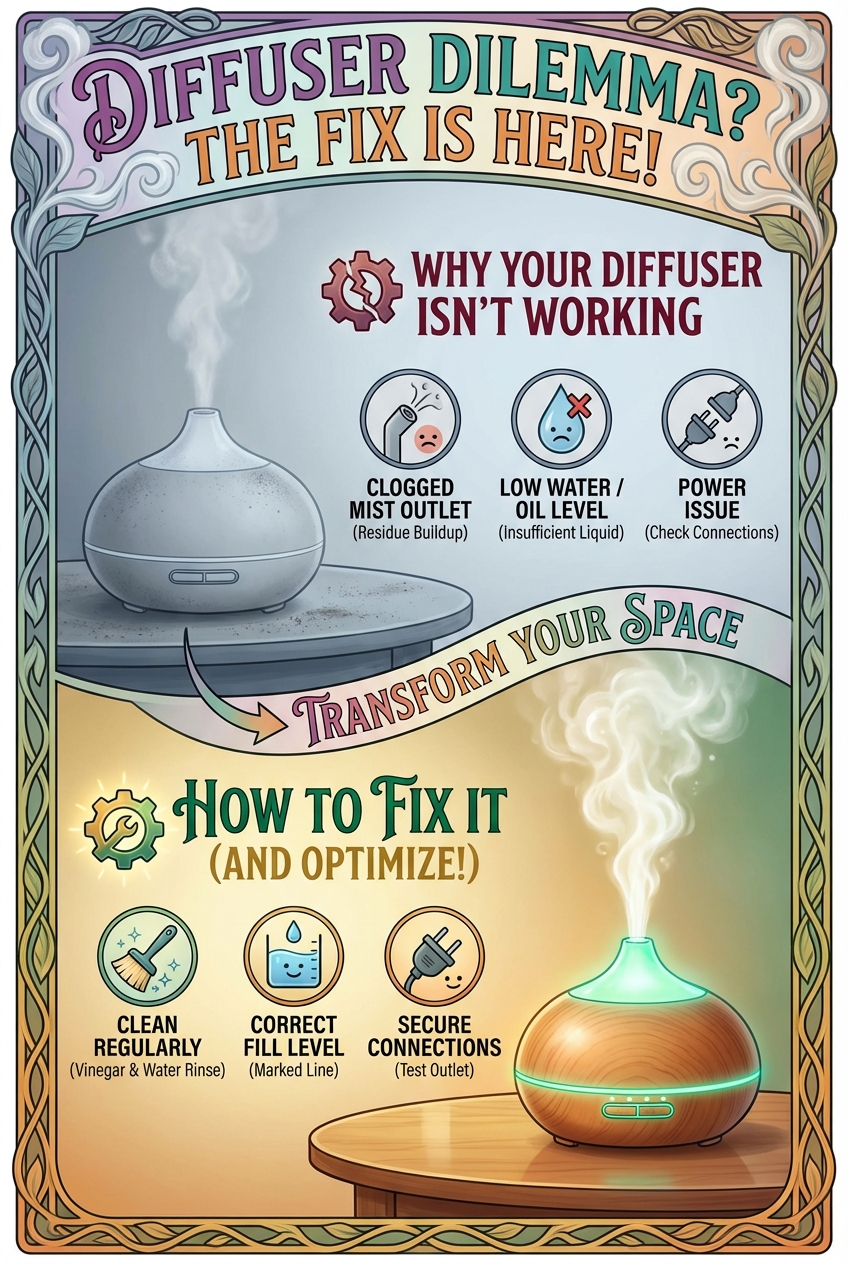
If your diffuser is making little or no mist, the cause is almost always mineral or oil buildup on the ultrasonic plate, too much or too little water, or the wrong spot in the room. Rarely is the machine actually dead. Start with a cleaning, then check the water level and the placement.
It's very common, so don't feel bad about it. Most of these fixes take ten minutes and a bottle of white vinegar.
Why is my diffuser not misting?
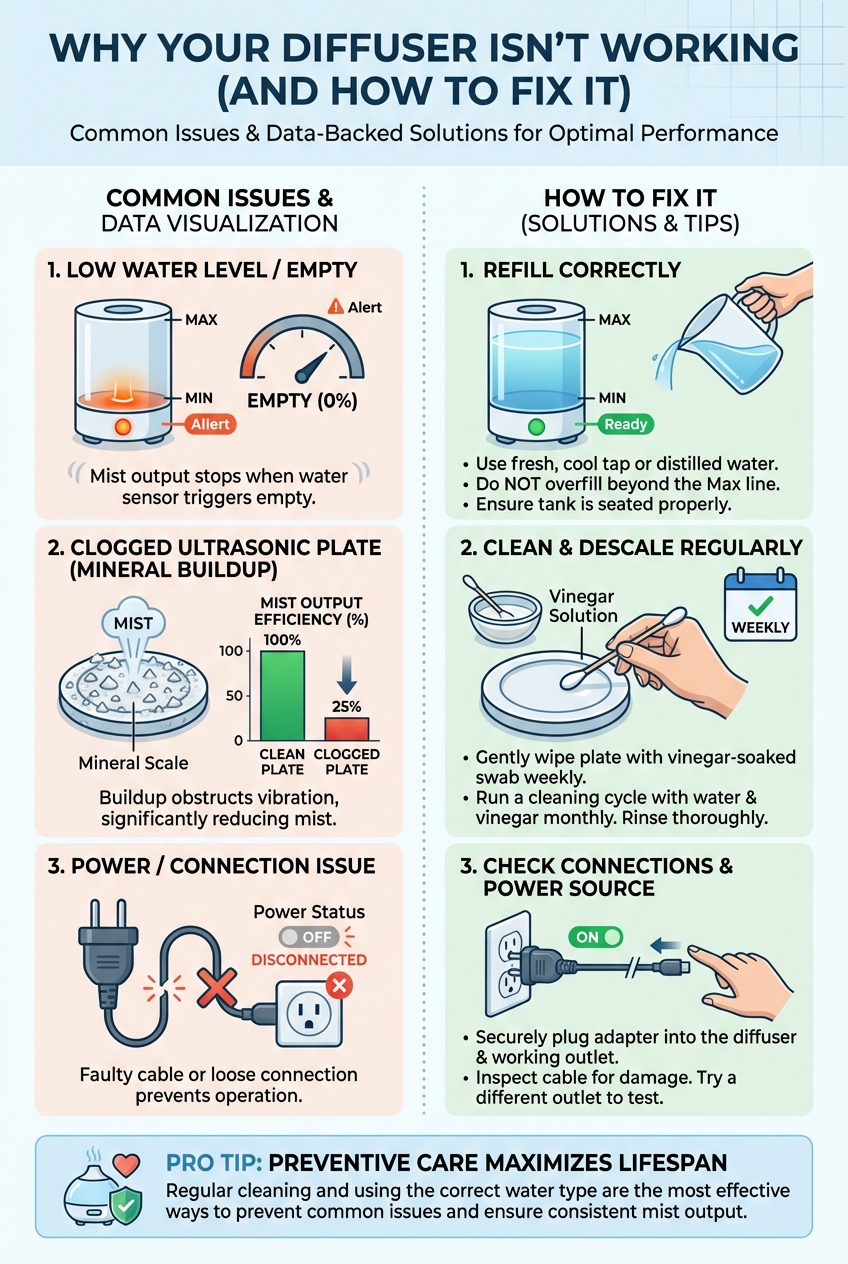
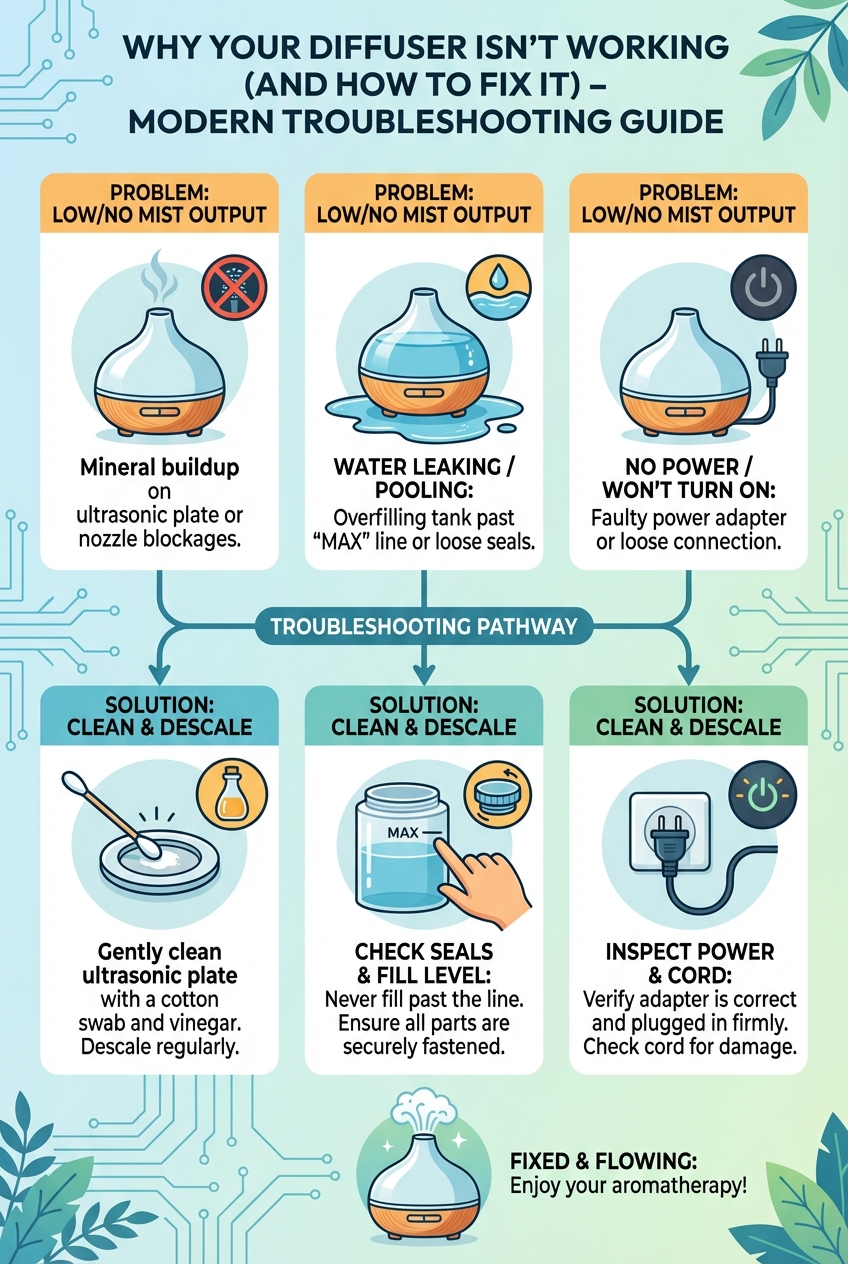
Ultrasonic diffusers use a small ceramic disc at the bottom of the tank that vibrates to break water into mist. When that disc is coated with lime scale or oil film, it can't vibrate properly, and the output drops to a weak trickle or stops.
Other common causes:
- The tank is filled past the max line, or is nearly empty so the auto shut-off kicks in.
- Too much oil in the water, which makes the mist heavy and can cause spitting or leaks around the base.
- Thick oils, such as carrier oils like jojoba or almond, mixed into the blend. They're great for skin and wrong for a diffuser.
- Oil residue built up in the lid's mist opening.
How do you clean a diffuser that stopped working?
- Unplug it and empty the tank.
- Fill the tank about halfway with clean water and a tablespoon of white vinegar. Run it for 5-10 minutes in a ventilated room to loosen mineral deposits.
- Empty it, then wipe the plate gently with a cotton swab dipped in rubbing alcohol. Press lightly. You're lifting a film, not scrubbing a pan.
- Wipe the inside of the lid and the mist outlet, where oil collects and drips back down.
- Rinse with plain water and let it dry before the next use.
If you use it daily, repeat this about once a week, and always between different oils so scents don't muddy each other. Check the manufacturer's manual first, since some brands recommend their own cleaning method.
Which water and how much oil should you use?
If your tap water leaves white crusty marks on kettles and faucets, use distilled water in the diffuser. That crust is calcium, and it's what coats the plate. Fill only to the max line; going over can keep the plate from working properly.
For oil, start small. A few drops (about 3-5) in a 100 ml tank is plenty, and more drops don't make the scent last longer. They just make the mist heavier. Choose products labeled as pure essential oil, not "fragrance oil," which is more likely to leave residue.
Where should you put a diffuser so the scent actually travels?
Placement is the second most common reason a diffuser seems weak. As an architect, I think about airflow in a room the way I think about circulation: scent follows the air, so look at where the air goes.
- Put it on a table, console or nightstand rather than the floor, so the mist disperses at breathing height.
- Keep it away from return vents, kitchen exhaust fans and open windows. They pull the mist out of the room before you smell it.
- Leave open space above it. A tight bookshelf traps moisture that can mark wood and book covers.
- Set it on a hard, level surface with a tray or coaster underneath to protect furniture from water rings. Soft surfaces like towels can block the base.
Size matters too. A small personal diffuser suits a bedside table or a desk, but it won't scent a big open living area. In a large room, I'd use two smaller units at opposite ends rather than one big one. If you want more on this, see the reed diffuser placement guide for how the same airflow logic works without a power cord.
Is a diffuser the right tool for getting rid of odors?
Not really. A diffuser adds scent; it doesn't remove what's causing the smell. If your goal is a natural odor eliminator for home use, ventilate and clean the source first, then add scent if you still want it.
A classic baking soda and vinegar odor remover routine is simple: baking soda in an open container or sprinkled on a rug or mattress before vacuuming, and a vinegar wipe-down on hard surfaces. Utah State University Extension notes that baking soda neutralizes acid-based odors in water and adsorbs odors from the air.
For a diy natural air freshener, a diffuser with a few drops of citrus or lavender oil is a fine finishing touch. It's also worth knowing that Salt Lake City's slcGreen blog reports that many plug-in air fresheners emit dozens of different VOCs, even those labeled "unscented" or "natural." Cleaning the source and opening a window beats covering the smell.
Is it safe to diffuse oils around pets?
Some essential oils, including tea tree and peppermint, are listed as risky for cats and dogs. Check with your vet before diffusing anything in a home with pets. Run the diffuser in a room where the animal can leave freely, keep the door open, and stop if your pet seems bothered.
Habits that keep it working
- Use the intermittent mode if your diffuser has one. Your nose adapts to a constant smell, so short bursts keep the scent noticeable.
- Choose a diffuser with a no-light mode for the bedroom, since glowing buttons can be distracting at night.
- Store your oils somewhere cool and dark, away from the window.
- Hide the cord behind a lamp or a decorative object so the unit looks intentional.
If you're still deciding what a diffuser can do for you, these essential oil diffuser benefits are a useful read. If water keeps pooling or the unit hums with no mist after cleaning, it may be time to contact the manufacturer.
Frequently asked questions
Why is there water around the base of my diffuser?
Overfilling, too many oil drops, or a tilted surface are the usual reasons. Set it on a level surface, fill only to the max line and use fewer drops of oil.
My diffuser hums but no mist comes out. What's wrong?
The plate is most likely coated with mineral or oil residue. Run a vinegar-and-water cycle, wipe the plate with a cotton swab and rubbing alcohol, and check that the water level is between the min and max lines.
Can I use perfume in a diffuser?
No. Perfume isn't made for diffusers and can damage the tank or plate. Use oils labeled for diffusing and follow the manual.
Filed under
ArticlesMeet the author
Written by an architect.
Julio Arco is a passionate architect with years of experience in architecture, interior design, urban design, and housing. He studied at prestigious universities across North America and Europe.

- Name
- Julio Arco
- Job
- Architect and online interior designer
- Studied
- Architecture, ITESM · Urban Design and Housing, McGill
- Partner
- Thor, Australian Shepherd
- Thor’s title
- Head of quality control