Room Divider Ideas for Every Layout and Budget
Room divider ideas for small spaces, living rooms and home offices, from curtains and bookcases to half walls, with sizes and budget picks.

By Julio Arco
Architect and online interior designer

In this post
- How do you decide which divider fits your room?
- Use curtains or drapery
- Style a bookcase or open shelving
- What are good room divider ideas for small spaces?
- Use folding screens for flexible separation
- Try a half wall or partial-height partition
- Consider sliding panels and glass partitions
- What is the cheapest way to divide a room?
- Divider ideas for a home office
- How do you use a room divider to hide a treadmill?
- Keep light moving through the space
- Frequently asked questions
The best room divider is the one that matches what you need from the separation: privacy, storage, a visual break, or just a hidden corner. Curtains and folding screens are the easiest and cheapest. Bookcases and half walls add storage and keep light moving. Sliding panels and glass partitions are the most permanent.
Below are the options I'd consider first, with sizes, trade-offs and notes for small rooms and homes with pets.

How do you decide which divider fits your room?
Start with a tape measure and a simple question: what do you need to separate, and from what? Privacy from a bed, a desk away from the TV, or an exercise corner out of sight each call for a different divider.
Then check three things:
- Light: does the area behind the divider depend on a window on the other side?
- Circulation: keep about 30-36 inches clear in main walkways.
- Permanence: do you rent, or might you rearrange in six months?
Solid dividers give more visual privacy and block more sound. Open or slatted ones keep a room bright and connected. Many people find a mix works best, such as a solid lower half with an open top.
Use curtains or drapery
A ceiling-mounted track and a heavy fabric panel is one of the most flexible dividers there is. You can draw it for privacy and open it when you want the full room. Heavy linen or wool also softens echo, which helps in open-plan spaces.
For cheap room divider ideas, a tension rod or a basic ceiling track with ready-made curtains costs far less than any built solution. Hang the rod as high as you can so the fabric reads as part of the wall. If a dog or cat shares your home, choose a washable fabric and hem it just above the floor so it doesn't collect fur and mud.
Style a bookcase or open shelving
A freestanding bookcase set perpendicular to a wall divides a room and gives you storage in the same footprint. An open-backed unit lets light pass through, and you can leave gaps on shelves to keep sightlines.
Anchor tall units to the wall or floor, especially around pets and kids. Put heavier items on the bottom shelves, and use baskets for the things you don't want on display. A low shelf at about waist height is a good middle ground: it marks the zone without closing the room in.

What are good room divider ideas for small spaces?
In a studio or a small bedroom, the goal is to separate without losing light. These tend to work best:
- A slatted wood screen, which hints at a wall while letting light through.
- A low console or storage bench behind a sofa to define a living area.
- A glass or reeded-glass panel, if the budget allows.
- A folding screen you can stow when guests leave.
Keep colors light and the divider's height below the ceiling when you can, so the full room still reads as one volume. As an architect, I'd pick a piece that does two jobs, like a bookcase with a desk surface, over a purely decorative screen.
Use folding screens for flexible separation
A folding screen is the simplest option for renters. It needs no tools, moves in seconds, and can hide a dog bed, a laundry rack or a messy desk. Look for a panel set that is stable when partly open, because a wobbly screen is easy for a pet to knock over.
Fabric panels absorb a little sound, wood lattice lets light through, and solid panels give the best privacy. For room divider ideas for privacy, choose the solid or lined type and go at least as tall as eye level when you're standing, roughly 5.5-6 feet.
Try a half wall or partial-height partition
Living room half wall room divider ideas work well when you want to separate a dining or entry area but keep the open feel. A wall about 36-42 inches high defines the zone, can carry a ledge or planters, and doesn't block light. Adding a glass or slatted top section raises privacy without making the room feel boxed in.
Structural or electrical changes should go through a licensed contractor, especially if the wall will hold outlets or sit near a load-bearing element.
Consider sliding panels and glass partitions
Sliding panels and pocket doors suit homes where the separation is only needed some of the time, like a home office that closes off at night. Glass and steel partitions keep daylight and give acoustic separation, though they cost more and need professional installation. Floor to ceiling room divider ideas in general give the strongest separation, so they suit larger rooms better than small ones.
If you like the look of glass but want privacy, reeded or frosted glass blurs what's behind it while passing light.

What is the cheapest way to divide a room?
The cheapest options are a tension-rod curtain, a folding screen, a row of tall plants on a low console, or a bookcase you already own. For DIY room divider ideas, a simple wood-slat frame, a hanging fabric panel on a ceiling hook, or stacked crates make solid projects with basic tools.
Plants make a lovely soft divider, but check with your vet or a pet-toxicity list before bringing any into a home with cats or dogs.
Divider ideas for a home office
A desk needs a visual break, not necessarily a wall. A bookcase, a curtain or a screen behind your chair removes the clutter from video-call backgrounds and tells your brain the workday ends when you step away. Add a rug under the desk area to mark the zone, and put a lamp on the work side so the divider doesn't leave it dim.
How do you use a room divider to hide a treadmill?
A room divider to hide a treadmill needs to be taller than the machine, which is usually around 5 feet with the console, and stable enough that it won't tip if someone brushes past. A three- or four-panel folding screen works, as does a curtain on a ceiling track, which also muffles some of the motor noise. Leave a few inches of space around the machine for airflow and keep the screen out of the walking path.
Keep light moving through the space
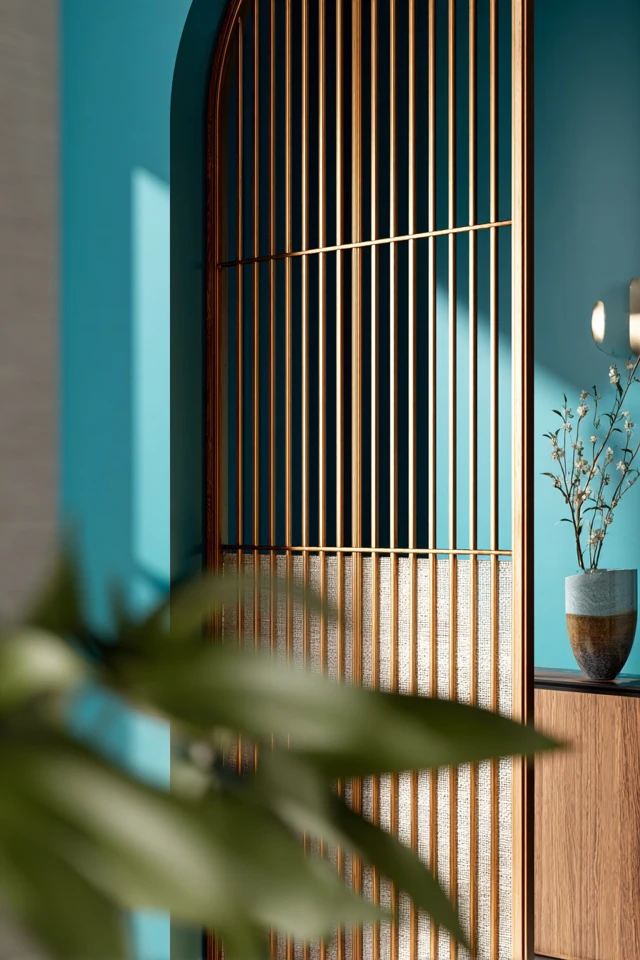
Light is what makes a divided room feel comfortable. Place dividers parallel to windows, not in front of them, and prefer open, slatted or glass types in the part of the room that gets the least daylight. Adding a lamp or an LED strip behind a slatted screen gives depth in the evening. Mirrors on the far wall also help bounce light into the darker zone.
Frequently asked questions
What is the cheapest way to partition a room?
A tension-rod curtain or a folding screen costs the least and needs no installation. A bookcase you already own can do the same job and add storage.
What can I use instead of a room divider?
Furniture works well: a sofa back, a low console, an area rug or a shelving unit can mark zones without a dedicated divider. Plants on a stand also soften the boundary.
How can you creatively divide a room?
Try a slatted wood screen, a ceiling-hung curtain, a half wall with planters, or a bookcase set at a right angle to the wall. Mixing a solid lower part with an open upper part gives privacy and light.
Do room dividers block sound?
Only partly. Heavy fabric, upholstered panels and solid units reduce echo and some noise, but for real sound privacy you'd need a full wall.
Filed under
ArticlesMeet the author
Written by an architect.
Julio Arco is a passionate architect with years of experience in architecture, interior design, urban design, and housing. He studied at prestigious universities across North America and Europe.

- Name
- Julio Arco
- Job
- Architect and online interior designer
- Studied
- Architecture, ITESM · Urban Design and Housing, McGill
- Partner
- Thor, Australian Shepherd
- Thor’s title
- Head of quality control