Staircase Wallpaper Ideas: Patterns That Work on Stairs

By Julio Arco
Architect and online interior designer
In this post
- Why use wallpaper on a staircase wall?
- Which wallpaper styles work best on stairs?
- What is the best wallpaper for a staircase wall?
- Small staircase wallpaper ideas
- How do you choose colors and pattern scale?
- What about wallpaper for stairs and landings?
- How do you install wallpaper on a staircase?
- Lighting and everyday upkeep
- Frequently asked questions
Yes, you can put wallpaper on a staircase, and the stair wall is one of the best places to use a pattern you love. You see it while moving, from changing angles, so pick a pattern that reads well from far away and a finish that survives scuffs, backpacks and the occasional dog shoulder.
The short version: vertical stripes or a large-scale mural for long flights, a small quiet repeat for tight stairwells, and vinyl or washable non-woven paper wherever hands and paws brush the wall.
Why use wallpaper on a staircase wall?
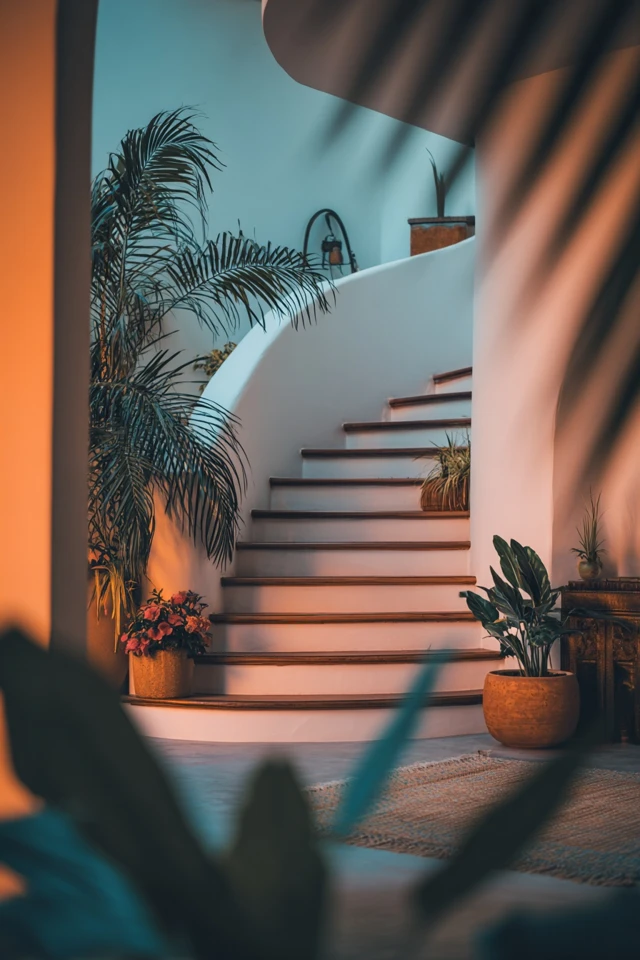
A stair wall is a long, uninterrupted surface with almost no furniture in front of it. That makes it a natural spot for a bold pattern you might hesitate to use in a living room. It also connects two floors, so the pattern can tie the rooms above and below together.
It's very common to treat stairs as leftover space and paint them builder white. Wallpaper is a low-risk way to give them a point of view, especially if you keep the rest of the hallway calm.
Which wallpaper styles work best on stairs?
Vertical stripes
Stripes draw the eye up and make a low ceiling feel taller. They are also forgiving: a slightly off line on a sloped stair run is less noticeable in a stripe than in a large geometric. Thin, low-contrast stripes feel quiet; wide, high-contrast ones feel graphic.
Murals and large botanicals
A mural suits a long, continuous wall because the image unfolds as you climb. Plan where the main motif lands: ideally at a landing or at the point where you first look up the stairs. Botanical scenes also soften the hard lines of treads and railings.
Geometric and 3D-effect patterns
Geometrics add rhythm that echoes the steps themselves. If you like a 3D wallpaper for a staircase wall, choose a printed optical effect or a lightly embossed texture over a heavily raised surface. Raised surfaces collect dust and catch on sleeves in a narrow passage.
Classic damask and heritage florals
Traditional patterns look current in modern colorways, such as soft gray on warm white or deep green on charcoal. They suit older homes with wood railings and paneling.
Texture and ombré
Grasscloth-look and textured neutrals add depth without a busy pattern. Real grasscloth marks easily, so as an architect I'd keep it above the handrail line or on a landing, not along the lower wall.
What is the best wallpaper for a staircase wall?
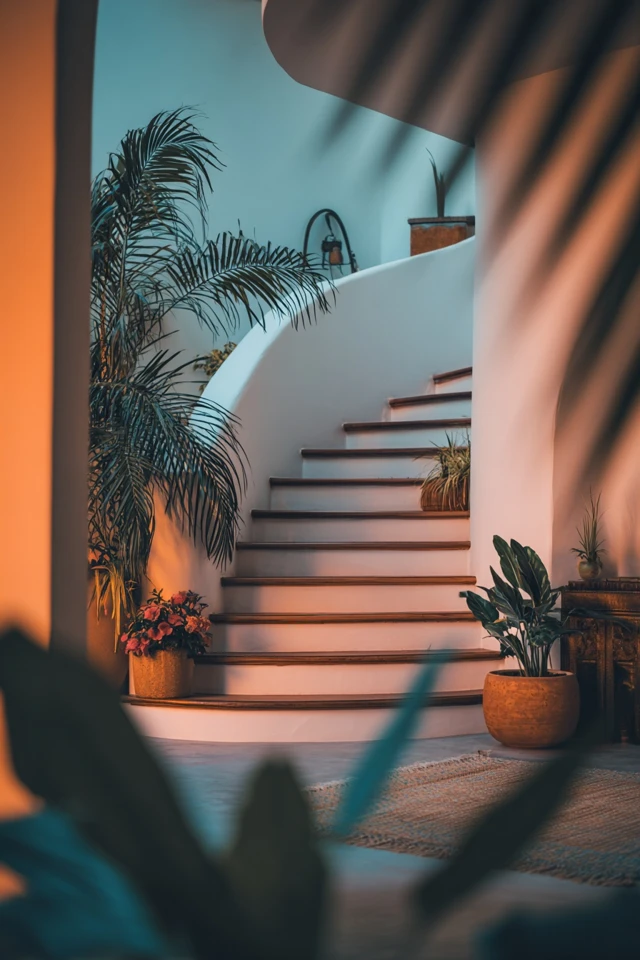
For most homes, the best wallpaper for a staircase wall is a washable vinyl or a vinyl-coated non-woven paper. Both wipe clean and resist abrasion, which matters along the handrail and the lower third of the wall.
- Vinyl and washable papers: the practical default for families and pets.
- Non-woven: stable, easier to hang because you paste the wall, and it often peels off dry later.
- Grasscloth and textile: warm and beautiful, best out of reach of hands.
- Metallic and foil: use sparingly, since they show every wall imperfection under angled light.
- Peel-and-stick: good for renters and for testing a bold pattern, though seams can lift on textured walls.
Matte finishes diffuse light and hide small flaws. Glossy or metallic ones bounce light and sharpen shadows, which can look lively at night but unforgiving on uneven plaster.
Small staircase wallpaper ideas
In a narrow stairwell you pass within arm's length of the wall, so a huge pattern can feel crowded. Choose a light background, a small or medium repeat, and low contrast. Vertical lines add height without closing in the space.
Another option is to paper only the upper part of the wall above a painted or paneled lower section. This protects the scuff zone and keeps the pattern from dominating. If you like that look, our guide to wall trim molding shows how to build the dividing line.
How do you choose colors and pattern scale?
Scale first, then color. Stand at the bottom, middle and top of the stairs and look at where your eyes naturally land. Large motifs read from the bottom of a long flight; small repeats work on short runs and enclosed landings.
For color, light changes everything. A stairwell with little daylight tends to make cool colors look flat and gray, so warmer tones usually work better there. A bright, sunlit stair can handle deeper colors without feeling like a cave. Tape up large samples and check them in the morning and at night under your actual bulbs.
If you want more examples, see these pages on modern wallpaper on stair walls and timeless stair wall wallpaper.
What about wallpaper for stairs and landings?
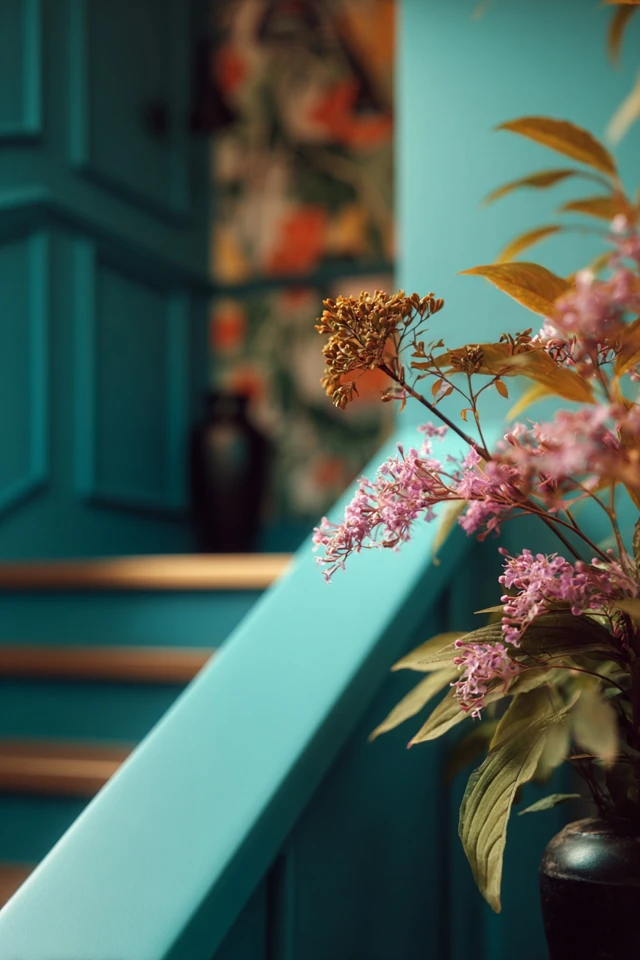
Treat the landing as a pause point. Match the pattern repeat across the corner so the motif doesn't jump, or switch to a coordinating plain color on the landing. Doorways at the top and bottom are good places to stop a pattern cleanly.
You can also paper the risers, the vertical face of each step. Peel-and-stick vinyl works here for renters, but keep it to risers that aren't kicked often, and don't cover treads, since slippery surfaces on a stair are a safety problem.
How do you install wallpaper on a staircase?
- Clean and repair the wall, then prime it so the paper adheres and can come off later.
- Measure the tallest point of the wall, where the stair rises, and cut your first strip long enough to cover it with extra at both ends.
- Draw a plumb line with a level. Stair walls slope at the top, so never trust the ceiling or the stair angle as a guide.
- Hang strips vertically, matching the pattern as you go, and trim along the slope with a sharp blade and a straightedge.
- Smooth out bubbles from the center outward and wipe off excess paste right away.
I recommend hiring a professional for mural-scale prints or complex repeats, because stairwells mean ladders, odd angles and a lot of waste if a cut goes wrong. Order a little extra paper, and keep a spare roll for repairs.
Lighting and everyday upkeep
Angled wall lights show off texture; flat overhead light tends to hide it. Good stair lighting also helps you see each step, which matters more than any pattern.
For households with pets, wipe the lower wall with a damp cloth and mild soap, which washable vinyl handles well. Avoid delicate textiles at dog height.
Frequently asked questions
What is the best wallpaper to decorate a staircase?
Washable vinyl or vinyl-coated non-woven paper is the practical choice. For pattern, vertical stripes and large murals suit long walls, while small, low-contrast repeats suit narrow stairwells.
Can you put wallpaper on a staircase?
Yes. Hang strips vertically from a plumb line and trim along the slope. Peel-and-stick works for renters, and complex murals are best left to a professional installer.
Should wallpaper follow the slope of the stairs or hang vertically?
Most installers hang panels vertically because it makes pattern matching and trimming easier. A mural that follows the slope is possible but needs careful planning.
How can I make a small stairwell feel larger?
Use light colors, vertical lines or a quiet small-scale pattern, and add layered lighting. Keep the steps clear of clutter so the eye travels up the wall.
Filed under
ArticlesMeet the author
Written by an architect.
Julio Arco is a passionate architect with years of experience in architecture, interior design, urban design, and housing. He studied at prestigious universities across North America and Europe.

- Name
- Julio Arco
- Job
- Architect and online interior designer
- Studied
- Architecture, ITESM · Urban Design and Housing, McGill
- Partner
- Thor, Australian Shepherd
- Thor’s title
- Head of quality control