Air Plant Types: How to Identify and Choose Yours
Learn the main air plant types, how to tell xeric from mesic Tillandsia, identify the one you own, and pick easy varieties for your home.

By Julio Arco
Architect and online interior designer

In this post
Most air plants sold for the home are Tillandsia, and the quickest way to sort them is by leaf look: silvery, fuzzy leaves mean a dry-loving (xeric) type, while smooth, green leaves mean a moisture-loving (mesic) type. That one distinction tells you how bright a spot to give the plant and how generous to be with water.
Below you'll find the popular varieties, a simple way to identify the plant on your shelf, and ideas for displaying them in a home with a dog or cat around.

What are air plants?
Air plants are Tillandsia, a group of bromeliads that grow without soil. They take in water through tiny cells on their leaves called trichomes, which, per Iowa State University Extension, absorb water from the air or rain. Those cells are also what give many species their silvery, fuzzy look.
There are hundreds of species, so any exact count depends on who you ask and how they classify them. For the home, a handful of widely sold ones cover almost everything you'll meet.
Xeric vs mesic air plants: the first thing to check
This is the most useful split for identification and care.
Xeric types
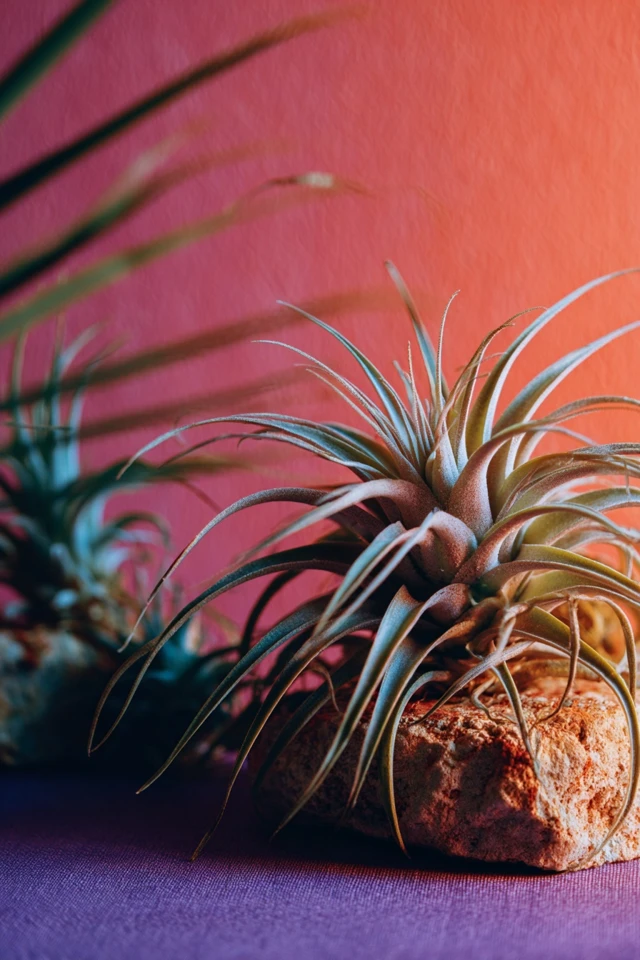
Xeric plants come from drier, sunnier places. Their leaves are thick, stiff and covered in a silvery layer of trichomes. They tolerate brighter light and dry out fast between waterings. Tillandsia xerographica, T. tectorum and T. ionantha lean this way.
Mesic types
Mesic plants come from more humid, shaded areas. Their leaves are thinner, greener and smoother, with fewer visible trichomes. They like a little more moisture and slightly gentler light. T. bulbosa and T. cyanea are common examples.
Many plants sit in the middle, so treat this as a spectrum. A very fuzzy, grayish plant can go in brighter light. A glossy green one should sit further from direct sun.

The most popular air plants
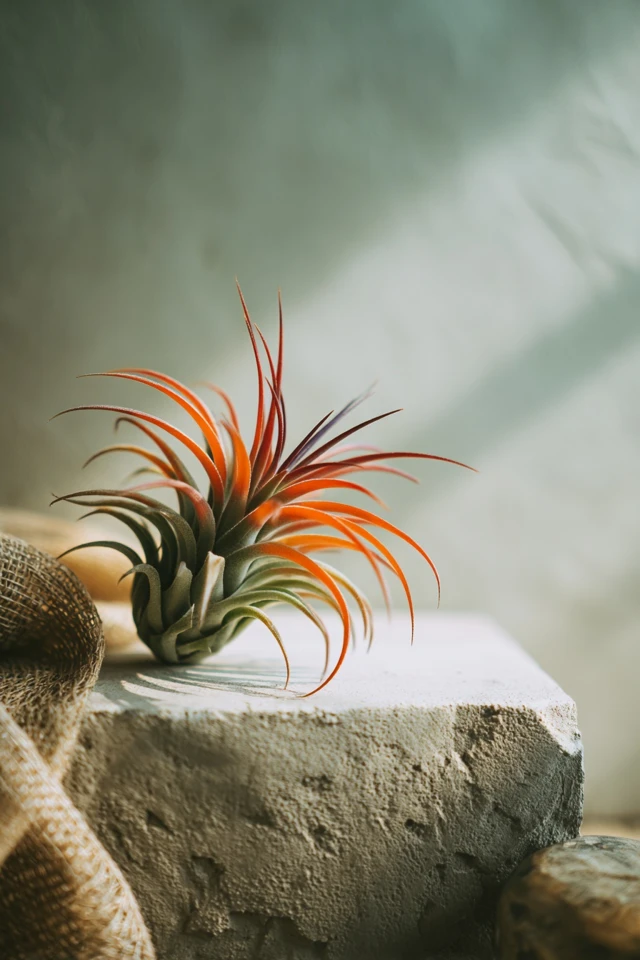
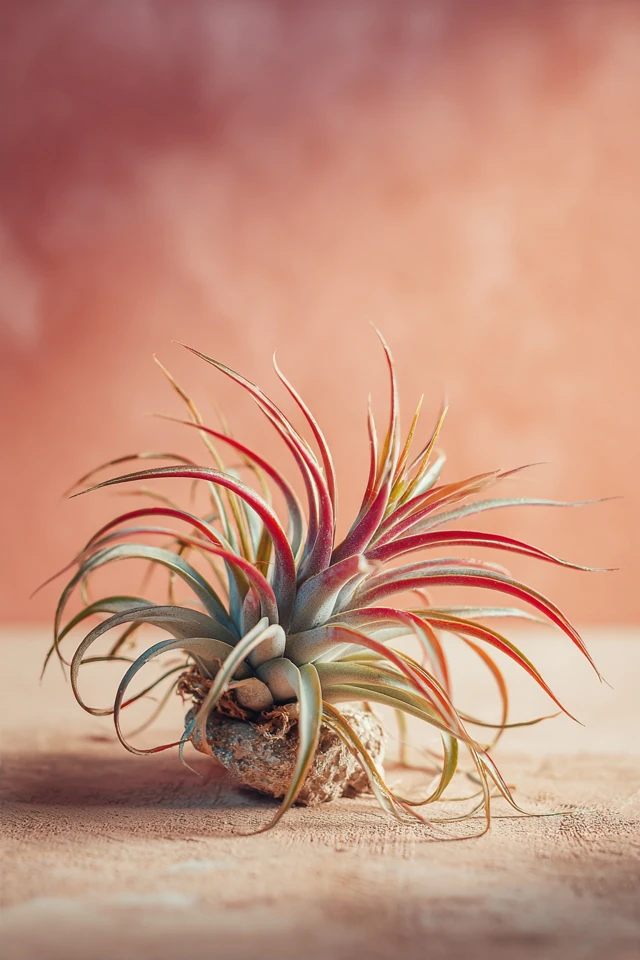
- Tillandsia ionantha: small, tufted rosettes that blush red-pink when they bloom. The classic starter plant.
- Tillandsia xerographica: a wide, sculptural silver rosette with curling leaves. Slow growing and a natural centerpiece.
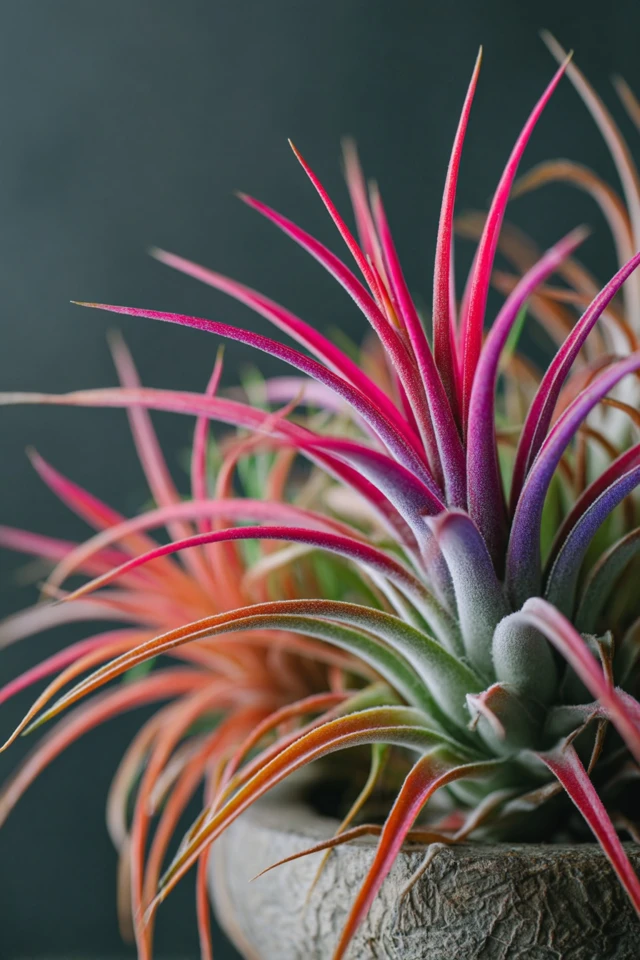
- Tillandsia stricta: stiff, narrow leaves in a fan shape, often with pink and purple flower spikes.
- Tillandsia bulbosa: a swollen base with twisting, tentacle-like leaves. Works well in a small group.
- Tillandsia tectorum: dense, almost white fuzz that looks like frost on a shelf.
- Tillandsia caput-medusae: bulbous base with curly leaves, similar in feel to bulbosa but usually more silver.
How to identify my air plant
Air plant species identification is mostly about four features. Go through them in order.
- Leaf color and fuzz: silvery and fuzzy points to xeric, green and smooth to mesic.
- Overall shape: a tight rosette (ionantha, xerographica), a fan (stricta), or a bulb-shaped base (bulbosa, caput-medusae).
- Size: ionantha stays small, often a few inches across, while xerographica can grow much larger over time.
- Leaf texture: stiff and curved suggests xerographica, thin and wavy suggests bulbosa.
If the plant came with a tag, trust that over a guess. Hybrids are common and can blur these clues, so a close match is often the best you'll get. That's fine, because care follows the xeric or mesic tendency more than the exact name.
Beginner friendly air plants
If you're new to them, start with T. ionantha, T. stricta or T. xerographica. They forgive the occasional missed watering better than thin-leaved mesic types, and they're sturdy enough to handle a move from shop to shelf.
Watering is where most plants go wrong. The University of Wisconsin Horticulture notes that improper watering is a primary cause of plant death. For air plants, Iowa State recommends submerging them in room temperature water for about 30 to 60 minutes, then shaking them out well so water doesn't pool in the leaves and cause rot. Xeric types usually want the shorter end of that range, and a spot where they dry within a few hours. For a full routine, see our guide to caring for air plants.
Light and placement
Bright, indirect light suits most air plants. The Iowa State guidance on houseplants points out that light drops quickly as you move away from a window, and areas more than a few feet from even bright windows are often too dim. So a shelf across the room from the glass is a decoration spot, not a growing spot.
Too little light brings faded leaves and stunted growth, while too much can burn them, according to Wisconsin Horticulture. If a silvery plant looks washed out or crispy, move it back a bit. If it looks stretched and dull, move it closer.
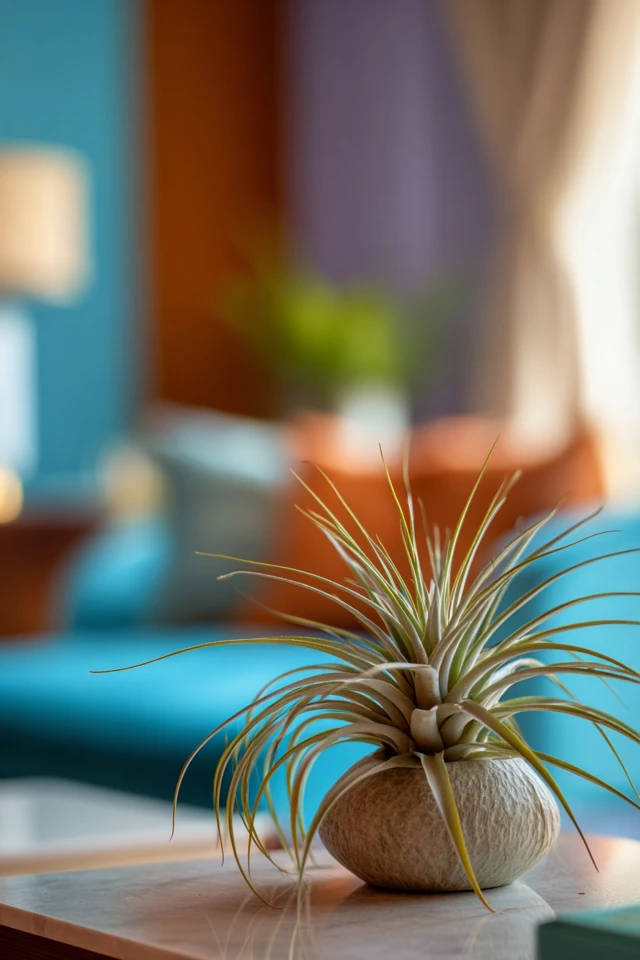
How to display air plants
Because they need no soil, you can put them almost anywhere that has light and airflow.
- Open glass globes or shallow dishes. Avoid sealed containers, since trapped moisture rots leaves.
- Driftwood, cork or wall frames for a hanging look that keeps surfaces clear.
- Groups of odd numbers, mixing one large rosette with a couple of small ones, so the arrangement feels balanced without being symmetrical.
- A pale or dark matte backdrop so silvery leaves read clearly. Against busy patterns they disappear.
As an architect, I recommend placing them where you can take them down easily for watering. A display you can't reach is a display that gets forgotten. If you share your home with pets, hang plants out of reach of chewing or batting, and check with your vet about any plant your animal might nibble. For more ideas on plant-filled rooms, our air plant ideas for refreshing your home is a good next stop.
Choosing by room
Bright living room or kitchen window: xerographica or tectorum, which handle strong light. Bathroom with a window: bulbosa or other mesic types, which enjoy the humidity. Home office desk near a window: a small ionantha cluster, easy to rotate and refresh. Open shelving in a drawing room: one statement xerographica with a few small companions.
Frequently asked questions
What are the different types of air plants?
Nearly all houseplant air plants are Tillandsia, grouped loosely as xeric (silvery, fuzzy, sun tolerant) or mesic (greener, smoother, more moisture loving). Common varieties include ionantha, xerographica, stricta, bulbosa and tectorum.
What are the top 10 most popular air plants?
Frequently sold favorites include T. ionantha, xerographica, stricta, bulbosa, tectorum and caput-medusae. Others such as brachycaulos, aeranthos, funckiana and cyanea round out the list, though popularity varies by shop.
How do I identify my air plant?
Check leaf color and fuzz, overall shape, size and leaf texture, then compare with the common species. If it's a hybrid, match it to the closest xeric or mesic type and care for it that way.
Are air plants good air purifiers?
They're nice to live with, but don't count on one to clean your air in any meaningful way. Choose them for how they look and how little space they need.
Filed under
ArticlesMeet the author
Written by an architect.
Julio Arco is a passionate architect with years of experience in architecture, interior design, urban design, and housing. He studied at prestigious universities across North America and Europe.

- Name
- Julio Arco
- Job
- Architect and online interior designer
- Studied
- Architecture, ITESM · Urban Design and Housing, McGill
- Partner
- Thor, Australian Shepherd
- Thor’s title
- Head of quality control