Beautiful Living Room With Tv Ideas for a Stylish Home
TV wall ideas for a living room: the right mounting height, what to put under a wall mounted TV, and how to style small rooms without clutter.

By Julio Arco
Architect and online interior designer
In this post
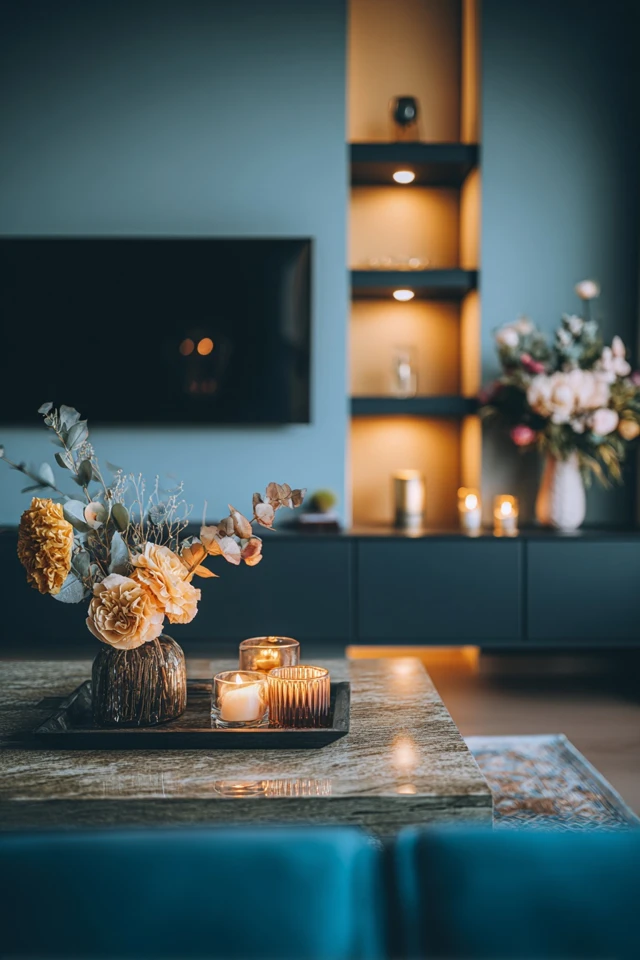
The simplest way to make a TV wall look good is to treat the screen as one element in a composition instead of the whole wall. Mount it with the center near seated eye level, give it a matte or darker backdrop, and balance it with storage, art or shelving on the sides and below.
If your TV currently floats on a blank wall with cables dangling, don't worry. It's one of the most common living room problems, and most of the fixes take an afternoon.
How high should a TV be mounted on the wall?
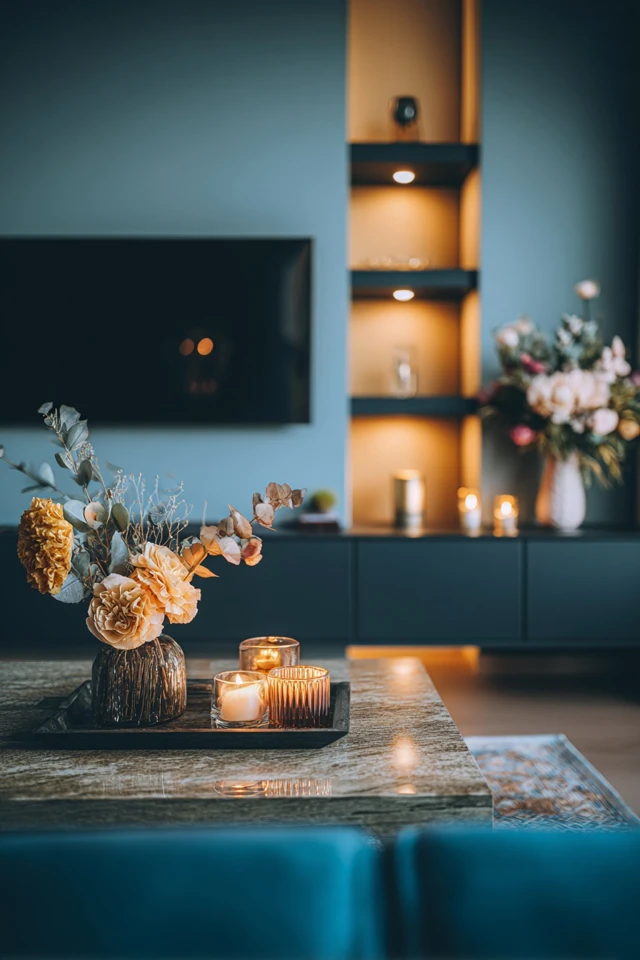
Start with your sofa. Sit down normally and note where your eyes land. The center of the screen should sit around that height, which for many sofas is roughly 40-44 inches from the floor. If you recline a lot, go a little lower. A TV mounted above a fireplace is the classic mistake: it forces you to tilt your head back, so I'd avoid it unless you have no other wall.
Viewing distance matters too. A common rule of thumb is to sit about 1.5 to 2.5 times the screen's diagonal away. For a 55-inch screen that is roughly 7-11 feet. Measure your sofa distance before you buy a bigger set.
Core principles for living room TV wall ideas
A few design principles do most of the work. Each one has a practical use on a TV wall.
- Balance: a large dark rectangle has visual weight. Offset it with a console, a tall plant, or a cluster of frames on one side.
- Contrast: a screen is a black void when it's off. A wall that is slightly darker than the rest of the room, in a matte finish, makes it recede instead of jumping out.
- Proportion: a tiny console under a big screen looks awkward. Make the furniture below at least two-thirds the width of the TV, and ideally as wide as it.
- Repetition: repeat a material, such as wood or brass, on the wall, the console and a nearby shelf so the area reads as one design.
Glossy surfaces bounce light and create reflections on the screen, while matte paint or plaster absorbs it. That's why I recommend matte finishes directly around the TV and saving gloss for elsewhere in the room.
What to put under a wall mounted TV
The space below the screen has a job: hold the things the TV needs and anchor it visually.
- A low media console with closed doors hides streaming boxes, game consoles and cables. Leave a gap behind it for airflow.
- A floating shelf or ledge works in tight rooms where floor furniture would crowd the walkway.
- Open shelving with baskets gives you storage that looks styled. Keep the top surface to two or three objects, like a lamp and a small plant.
- A soundbar can sit on the console or mount directly below the screen. Match its width to the TV.
If you have a dog or cat, closed storage is the safer choice for cords and power strips, and a stable low console is harder to knock over than a spindly table. Run cables inside the wall with a recessed kit or a paintable raceway. For in-wall power, hire a licensed electrician.
How to decorate a living room with a mounted TV
Surround it with art or shelving
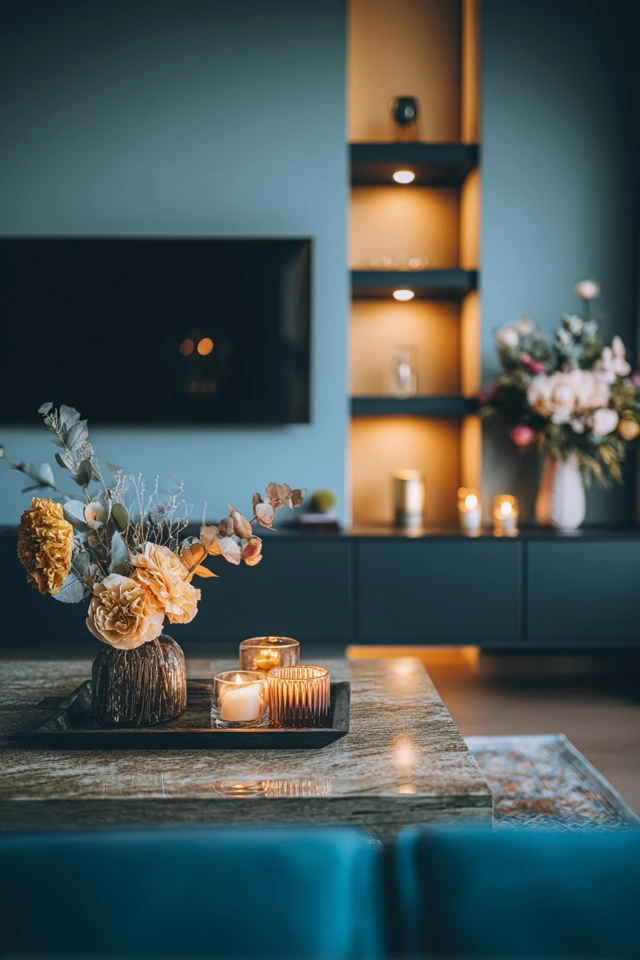
Frames on both sides, hung at different sizes but with a shared color or frame finish, soften the screen's hard edges. Built-in shelves on either side of the TV are the more permanent version. As an architect, I like asymmetry here: open shelves on one side and closed cabinets on the other keep a big screen from looking boxed in.
Use paint, paneling or wallpaper
Slim wood slats, board-and-batten, or a plaster-look paint turn the wall into a backdrop. Pick a muted tone. Saturated colors across a large plane tire the eyes, especially next to a bright screen. Greige, soft taupe and warm gray are easy, and a deeper shade in matte works if the room gets good daylight. Test swatches at different times of day first. For more on trim and paneling profiles, see our molding ideas.
Hide it when it's off
A framed-style TV, sliding panels or a cabinet with doors can make the screen disappear. It's a good route if you want the room to feel calm when nobody's watching.
Small living room ideas with TV
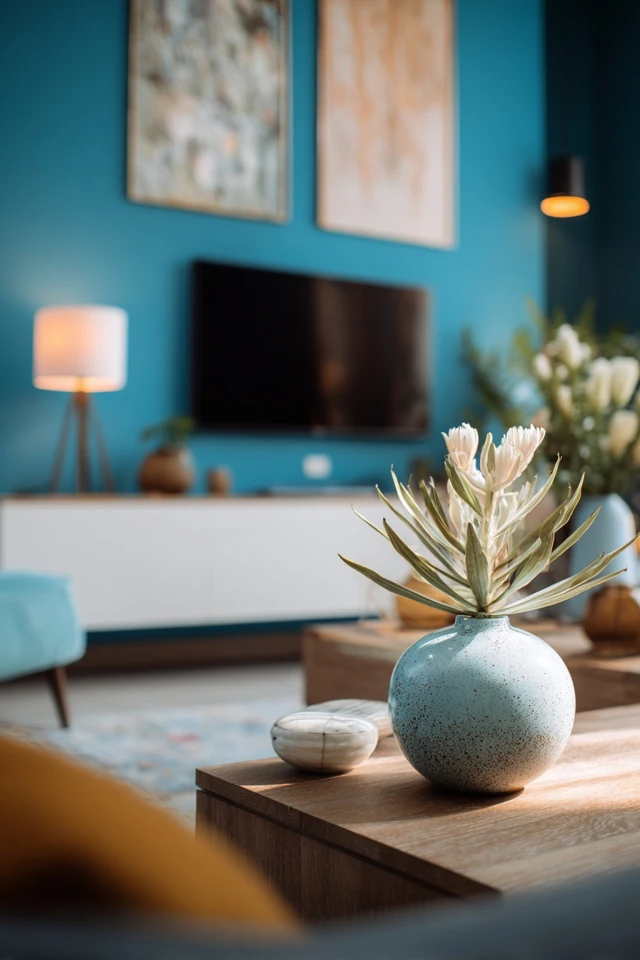
In a small room, mounting is the biggest win because it frees floor space. Pair it with a narrow wall-hung shelf instead of a deep console, and choose a sofa with exposed legs so you can see the floor underneath. Light wall colors and a mirror placed to the side (not opposite the screen) make the room feel larger without adding glare.
Keep about 30-36 inches clear for the main walkway. If the TV wall is also the entry wall, a slim console keeps that path open. More layouts for tight spaces are in these apartment living room ideas and these small TV room ideas.
Control glare and light
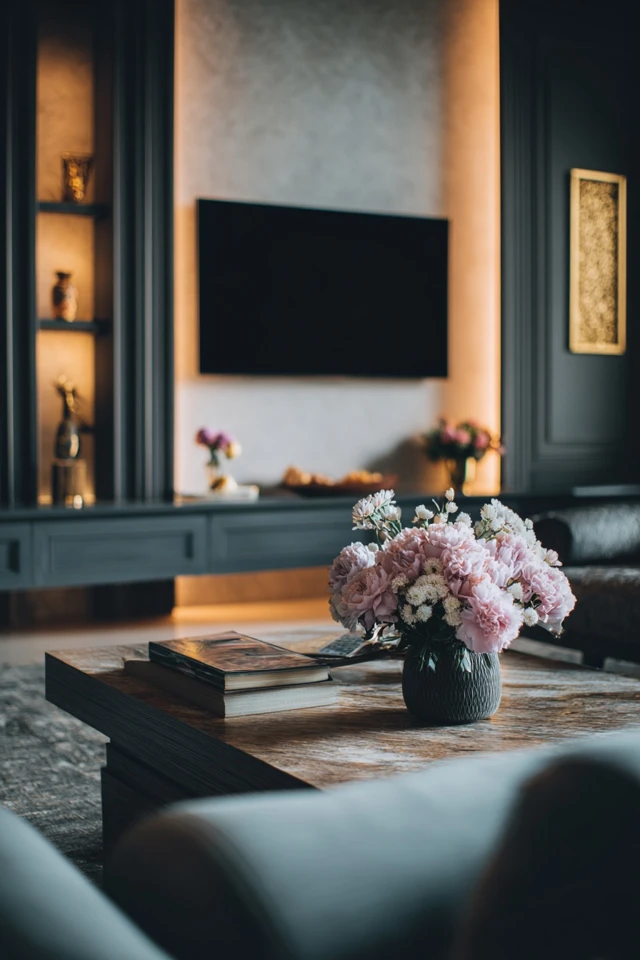
Place the TV perpendicular to a bright window, not opposite it. Sheer curtains diffuse daylight, and dimmable lamps reduce the contrast between the screen and the wall around it. Layer lighting: a ceiling light, a reading lamp, and a small accent light such as a picture light or a lamp on the console.
A rug that is large enough to hold at least the front legs of the sofa and chairs ties the media zone together. Wool rugs and heavy drapes also absorb sound, which helps with echo. For wider room ideas around a screen, take a look at this TV room guide.
Mounting checks before you drill
- Find the studs, or use anchors rated for your TV's weight if the wall is hollow or masonry.
- Choose a bracket by VESA pattern and weight rating, both listed in the TV's manual.
- Use a tilting or swivel arm if you can't mount at eye level or if windows cause reflections.
- Mark the center line with painter's tape and live with it for a day before drilling.
Frequently asked questions
What to put under a wall mounted TV in a living room?
A low console with closed storage is the easiest choice, since it hides cables and devices. A floating shelf or a few baskets on open shelving also work, especially in small rooms.
What are some creative ideas for mounted TV walls?
Try slatted wood paneling, a darker matte paint, built-in shelves on both sides, or a gallery of frames around the screen. A framed-style TV or sliding panel can hide it when off.
What are some good ideas for placing a TV in the living room?
Choose a wall that is not directly opposite a bright window, with the sofa about 1.5 to 2.5 times the screen diagonal away. Avoid mounting it too high above a fireplace.
What paint colors work best around a TV?
Muted neutrals like greige, soft taupe and warm gray are safe. A slightly darker matte shade behind the TV helps reduce glare and makes the screen blend in.
Filed under
ArticlesMeet the author
Written by an architect.
Julio Arco is a passionate architect with years of experience in architecture, interior design, urban design, and housing. He studied at prestigious universities across North America and Europe.

- Name
- Julio Arco
- Job
- Architect and online interior designer
- Studied
- Architecture, ITESM · Urban Design and Housing, McGill
- Partner
- Thor, Australian Shepherd
- Thor’s title
- Head of quality control