Wood Burning Ideas for Beginners: Projects to Try

By Julio Arco
Architect and online interior designer

In this post
The best wood burning ideas for beginners are flat, small and forgiving: coasters, a cutting board, a spoon, a keychain or a simple sign. Pick a smooth, pale wood, trace a simple pattern in pencil, and go slowly with a basic pen-style burner.
It's very common to feel nervous before the first burn, since you can't erase a line. That's fine. Start on scrap wood, and you'll learn more in twenty minutes than from any amount of reading.

What tools and materials do you need?
A starter kit is a pen-style wood burner with a few interchangeable tips, a heat-safe stand, pencils, graphite or transfer paper, and fine sandpaper. Add a cotton rag and a bowl of water within reach, because a burner stays hot after you switch it off.
Choose pale, fine-grained wood. Basswood, birch and poplar burn evenly and show lines clearly. Pine is cheap but has resin and uneven rings, so lines wander. Sand the surface smooth first, since rough grain catches the tip and makes lines jump.
How do you do wood burning for beginners?
- Sand the board, then wipe off the dust.
- Draw or transfer your design in pencil.
- Let the burner heat fully, then test a line on scrap.
- Pull the pen toward you in a steady motion. Slow movement gives dark lines, fast movement gives light ones.
- Shade by making many small, light strokes instead of pressing hard.
- Sand lightly when done and seal food-contact items only with a finish labeled food-safe.
Go with the grain where you can. Burning across hard growth rings gives patchy lines, so pick a design that suits the board.
Wood burning safety tips
Work in a ventilated spot, because burning wood gives off smoke, and open a window or run a fan. Never leave a hot pen on the table. Keep pets and kids out of the room while it's on, since a curious dog and a dangling cord are a bad mix. Don't burn plywood glue layers, painted wood or treated lumber, which can release unpleasant fumes. Check your burner's manual for its own limits.
Easy wood burning projects for beginners
Coasters
Round or square wood coasters are the classic first project. A border, a leaf outline or a simple geometric repeat looks good and hides small wobbles. A set of four also lets you improve as you go.
Spoons and kitchenware
Wooden spoons and small boards take a pattern well on the handle. Keep the burned design away from the bowl of the spoon, and leave the working surface plain.
Cutting boards and serving boards
A bigger board gives room for a monogram, a herb sprig or a border. Burn only one edge or corner, so knives never run over the design.

Signs and wall art
A house number, a family name or a simple line drawing on a plank works well. Print your lettering, transfer it, and go over it letter by letter. Hang it with the same care as any piece of art, as in a small room where every wall counts.
Small gifts: keychains and ornaments
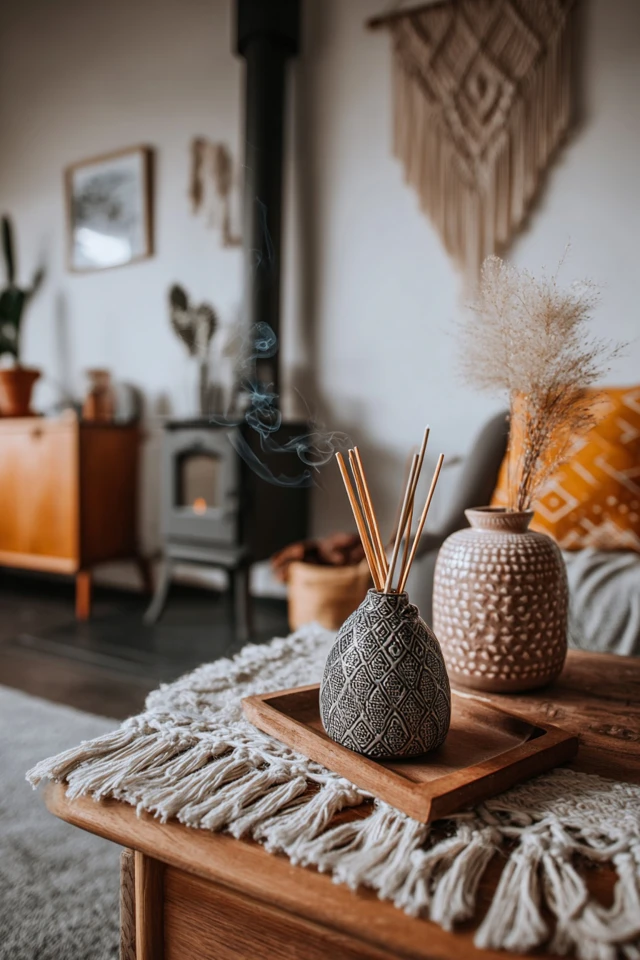
Small wood burning ideas such as slice ornaments, tags and keychains finish in an evening. Initials, a paw print, a mountain line or a star are enough.
Wood burning ideas for couples and gifts
Matching coasters with each person's initial, a wedding date board, or a pair of ornaments marking a first home are easy to personalize. Burn the lettering lightly first and darken it once you like the spacing. These are also the projects people most often turn into wood burning ideas to sell, as small, repeatable items. If you plan to sell, practice until your lines are consistent across a whole batch.

Where to find patterns
Free patterns are easy to find, but check each one's terms before you sell anything made from it. Simple shapes (botanicals, mountains, stars, borders) are the best start. You can also trace your own sketch, which avoids any question of reuse.
Burning wood versus burning for heat
If you also heat with wood, the same habit of choosing dry wood applies. The EPA notes that wood burns best at a moisture content of less than 20 percent. It also says properly seasoned wood is darker, weighs less and sounds hollow when knocked against another piece. For pyrography, use kiln-dried craft wood from a hobby supplier, which is already dry. As an architect, I'd also point out that stoves affect indoor and outdoor air. The California Air Resources Board is cited by the Iowa DNR as determining that the inhalable particle pollution from one wood stove is equivalent to that from 3,000 gas furnaces producing the same heat per unit. Ventilate your craft area, and have any stove installed and inspected by a licensed professional.
For more home project ideas, try a garage workspace, which also gives you a good place to burn with the door open.
Frequently asked questions
What types of wood should you not burn?
Avoid painted, stained, treated or glued wood such as plywood and pressure-treated lumber, which can give off harmful fumes. Resinous pine also burns unevenly for pyrography.
How to burn wood decoratively?
Trace a pattern in pencil, then follow it with a pen-style burner at a steady pace. Vary line darkness by speed and shade with light, repeated strokes.
What is the best wood for beginners?
Basswood, birch and poplar are smooth and even, so lines stay clean. Sand them before you start.
Filed under
ArticlesMeet the author
Written by an architect.
Julio Arco is a passionate architect with years of experience in architecture, interior design, urban design, and housing. He studied at prestigious universities across North America and Europe.

- Name
- Julio Arco
- Job
- Architect and online interior designer
- Studied
- Architecture, ITESM · Urban Design and Housing, McGill
- Partner
- Thor, Australian Shepherd
- Thor’s title
- Head of quality control